
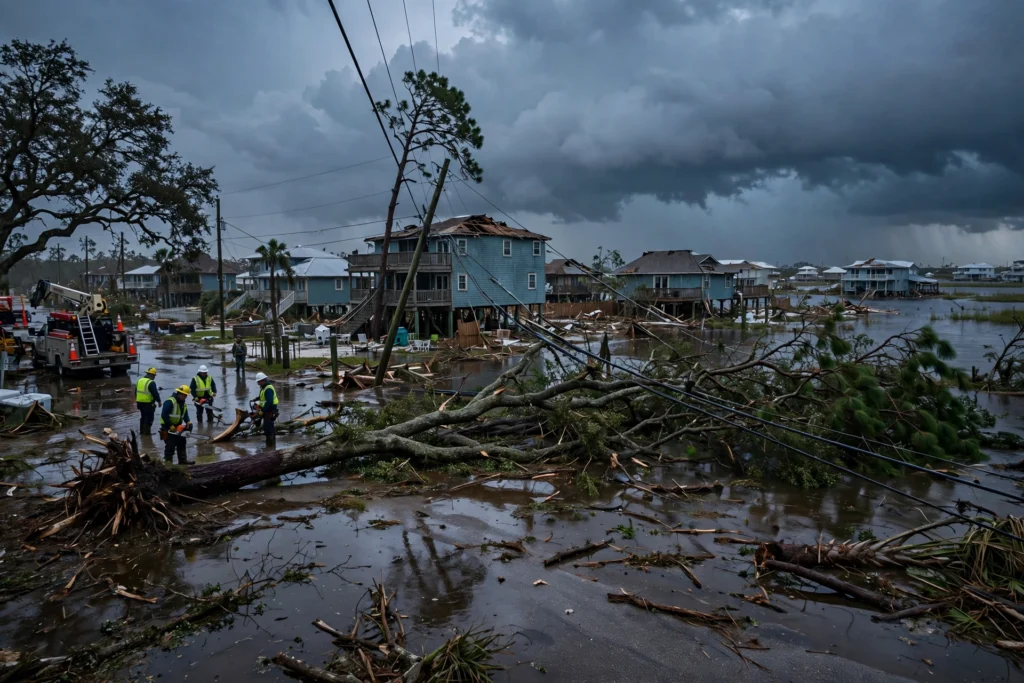
Hurricane Isaias Leaves Hundreds of Thousands Without Power
Hurricane Isaias made landfall near Destin, Florida, on Friday night as a Category 2 storm, according to the National Hurricane Center, bringing hurricane-force winds, heavy rain and storm surge to the Florida Panhandle and parts of Alabama before weakening as it moved inland.
By early Saturday, October 10, utility trackers and local officials reported hundreds of thousands of customers without electricity across Florida, Alabama and Georgia. Electric cooperatives said crews began damage assessments at daybreak, focusing first on downed lines, fallen trees and flooded roads that blocked access to coastal neighborhoods.
Hurricane Isaias damage across the Florida Panhandle
Officials in Okaloosa and Escambia counties reported significant wind damage, debris on major roads and flash flooding in low-lying areas. The National Weather Service in Mobile noted strong gusts reported on Santa Rosa Island and near Milton, and warned residents to avoid travel where power lines and trees were down.
In Milton, a city spokeswoman described damage around City Hall as extensive, with trees fallen and some access roads impassable, according to local reports. City Hall itself was reported spared, and officials said crews were working on generator power while assessment continued in surrounding communities including Bagdad and the Garcon Point area.
- Landfall near Destin, Florida, Friday night as a Category 2 hurricane
- Winds diminished to about 35 mph by early Saturday as the system became post-tropical
- Storm surge reported around 3 to 4 feet in parts of the Panhandle coast
- Flash flood risk continued inland across Alabama and the Southeast
Power restoration and safety guidance
Electric cooperatives serving the Gulf Coast said more than a quarter-million co-op members lost power in Florida, Alabama and Georgia. Choctawhatchee Electric Cooperative and Escambia River Electric Cooperative were among the hardest hit, according to cooperative updates, with large shares of their systems offline early Saturday.
Florida Governor Ron DeSantis said at a Saturday morning briefing that the remnants of the storm had left Florida but flooding remained a concern, with forecast rain totals of 4 to 8 inches across parts of the Panhandle and Big Bend. He said state bridges had reopened and Interstate 10 and US 98 were open, while smaller roads still had debris.
The National Hurricane Center issued its final advisory early Saturday after downgrading the system, noting that all watches and warnings had been dropped. The National Weather Service urged residents to use generators only outdoors, avoid standing water and treat flooded roads as unsafe.
Distribution points and local response
Okaloosa County announced a Point of Distribution site opening Saturday at the Destin-Fort Walton Rigdon Center in Fort Walton Beach, offering bottled water, tarps and ready-to-eat meals, according to county updates. Officials said additional sites would be established as supplies became available.
One death was reported in Escambia County after a tree fell on a home Friday night, the Escambia County Sheriff’s Office told USA TODAY. A second death was later reported in coverage of the storm, though officials said details were still being confirmed as assessment continued.
What happens next after Hurricane Isaias
Forecasters said heavy rain would push inland over the Appalachian region and into the Mid-Atlantic through the weekend, with isolated tornadoes possible in parts of the Southeast. Residents in affected counties were advised to follow local emergency management updates and utility outage maps for restoration estimates.
State officials said insurance assistance sites were being planned to help residents file claims quickly. Cleanup is expected to take days in the hardest-hit coastal communities, where saturated ground and fallen trees complicated restoration work.
This is a developing story and will be updated as officials release verified damage and restoration figures.
Why this storm mattered for the Gulf Coast
Isaias was described by cooperative officials as the first hurricane to hit the Gulf area in two years and the first Atlantic hurricane of the year to make US landfall, adding to its significance for emergency managers who had spent the week staging crews, fuel and replacement poles along the coast. Saturated ground from days of rain before landfall increased the risk of trees falling onto lines, a pattern utility officials cited repeatedly on Saturday.
For residents, the immediate priorities were safe drinking water, road access and information. County emergency offices used social media and local radio to share distribution sites and road closures, and officials repeatedly warned against driving through standing water or approaching downed lines, which may still be energized.
Tourism and small business owners in Destin, Fort Walton Beach and Panama City Beach also began assessing damage to docks, boats and beachfront property as seas calmed. Harbor reports described boats tossed by surge and rough water, though a full damage estimate from state or federal agencies had not been released by Saturday afternoon.
Federal forecasters will review the season’s landfall data in the coming days, and the National Hurricane Center’s final report on Isaias is expected to document wind, surge and rainfall totals across the Southeast.
Pingback: Tropical Storm Rachel Floods Southern California Coastline - RadioSea
Pingback: Hurricane Polo Flooding: Arizona & New Mexico Updates - RadioSea
Pingback: Florida dangerous surf rip currents: weekend warning