
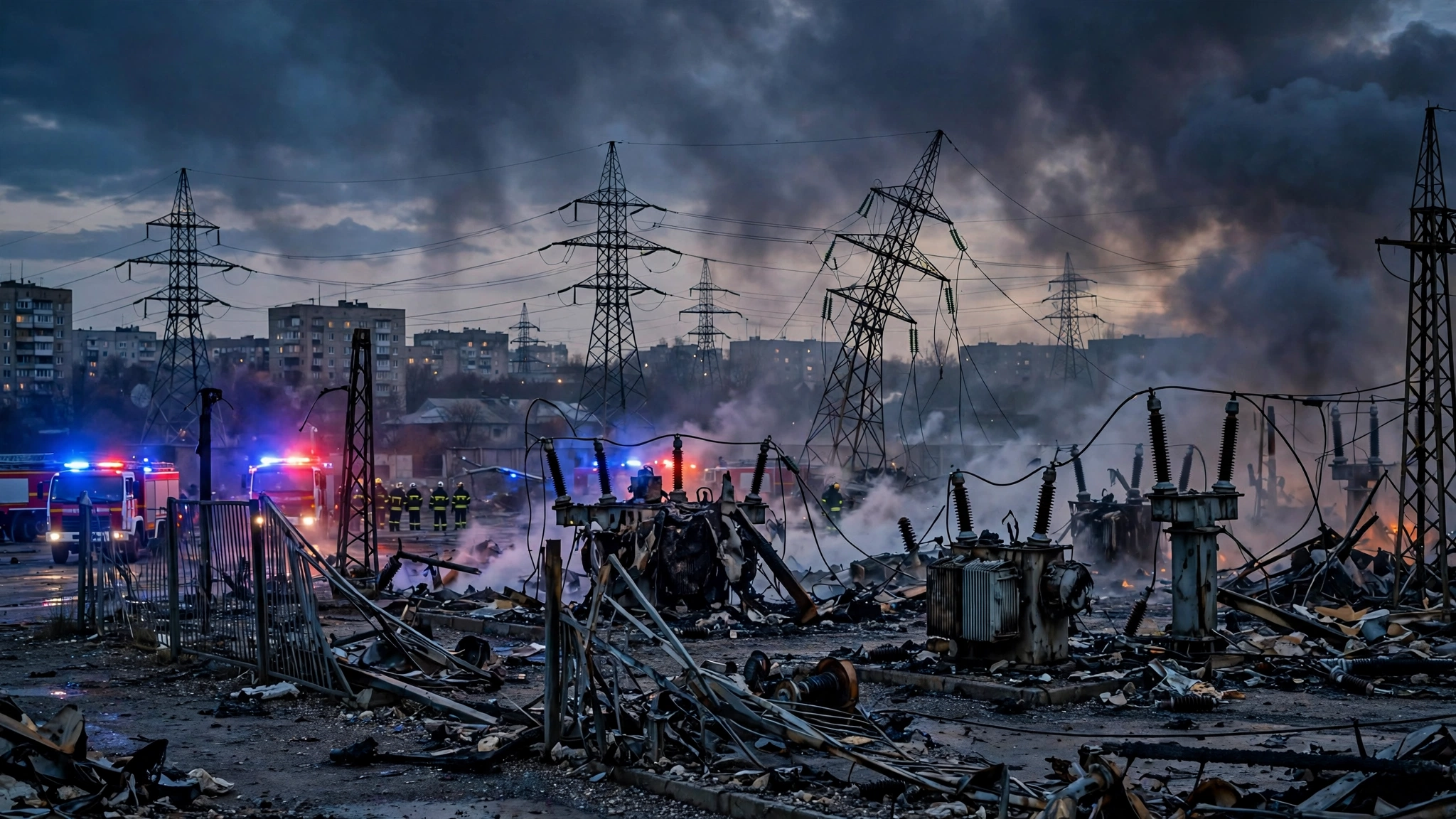
Russia battered Ukraine’s power grid again on Monday, leaving more than 600,000 people without electricity in the Dnipropetrovsk region alone, hours before Russian and Ukrainian delegations were due to meet for new U.S.-brokered peace talks in Abu Dhabi. The Russia Ukraine power grid strikes are the latest in a campaign to deny Ukrainian civilians heating, light and running water as winter approaches.
Russia’s Ministry of Defense said on Monday that it had targeted four electrical substations in Ukraine’s Kyiv, Dnipropetrovsk, Cherkasy and Vinnytsia regions. Ukraine’s air force said Russia launched 317 drones of various types overnight, including 105 jet-powered drones, alongside more than 30 ballistic missiles. President Volodymyr Zelenskyy said 12 Ukrainian regions came under attack, with Kyiv hit hardest.
Power company DTEK reported damage to major facilities in the Dnipropetrovsk region, leaving more than 600,000 people without power. Authorities in the Kharkiv region said a Russian drone had struck critical infrastructure, causing outages affecting about 250,000 customers. Kyiv’s three million residents were down to two or three hours of electricity a day, according to reports, and the attacks damaged electricity transmission lines, residential buildings and key transport infrastructure, including a major bridge over the Dnipro River.
More than 350 strikes since September
Ukraine’s energy minister, Denys Shmyhal, said the country’s power grid has been hit more than 350 times since September. Zelenskyy said Moscow was stepping up its bombardment campaign specifically to weaken Kyiv’s hand ahead of negotiations, a charge the attacks’ timing appears designed to underline.
The strikes also hit substations connecting the Rivne and Khmelnytsky nuclear power plants to Kyiv and central Ukraine, according to reports. On November 8, the Russian-occupied Zaporizhzhia nuclear power plant lost its only working external power connection and spent ten hours running on diesel generators before the grid came back through a single line, a reminder that the energy war carries nuclear safety risks as well as civilian hardship.
Zelenskyy said on Monday that the European Union had agreed to activate a special emergency mechanism that speeds up funding for power grid repairs. The mechanism is intended to get money to Ukraine’s energy system faster as the country braces for another harsh winter with its infrastructure under sustained attack.
Ukraine hits back at a Russian refinery
Ukrainian forces struck back overnight, hitting one of Russia’s largest oil refineries. The governor of the Leningrad region, Alexander Drozdenko, said Ukrainian drones started a fire at the KINEF refinery near St. Petersburg, more than 1,200 kilometres from the Ukrainian border. Drones also struck an industrial zone at Kirishi, about 100 kilometres from St. Petersburg, according to monitoring reports.
The exchange of long-range strikes on energy infrastructure in both countries has become a pattern in the war, now nearly five years old. Russia targets Ukraine’s electricity and heating; Ukraine targets Russia’s oil refining and export capacity. Both sides are using the days before the Abu Dhabi talks to demonstrate leverage.
What happens in Abu Dhabi
Delegations from Moscow and Kyiv are due to meet in Abu Dhabi on Tuesday and Wednesday for two days of U.S.-mediated talks on how to end the fighting. The working-level negotiations, announced by U.S. Special Envoy Steve Witkoff, will look at what security guarantees would satisfy Russia, which sees NATO as a threat, and Ukraine, which wants to prevent future Russian invasions. Witkoff and Jared Kushner are set to lead the American delegation.
President Donald Trump said in a “60 Minutes” interview that aired on Sunday, November 8, that the two sides are “very close” to a deal. Kremlin spokesperson Dmitry Peskov said on Monday that the meeting would focus on trilateral negotiations, with the United States mediating between Russia and Ukraine. Moscow says European officials will not be involved in the discussions, but French Foreign Minister Jean-Noel Barrot said on Sunday that France and other European representatives would be in the United Arab Emirates. U.S. Secretary of State Marco Rubio said progress has been made on a postwar security architecture for Ukraine.
Why the Russia Ukraine power grid strikes matter
The timing of the strikes, on the eve of the first U.S.-brokered talks between the two sides since February, is the point. Russia’s campaign against the grid is not only a military tactic but a negotiating one, aimed at showing Kyiv and its allies the cost of continuing the war through the winter. Ukraine’s refinery strikes send the opposite message: that Moscow’s own energy revenues are not safe either.
For the civilians caught between the two campaigns, the consequences are immediate. Hundreds of thousands of people face the coming cold with limited power, and no restoration date has been given for the Kharkiv region. Emergency crews have themselves been targeted: a Russian drone struck rescue workers at the site of a deadly strike in southern Ukraine on Sunday, according to the Associated Press, in a village where an earlier attack killed at least 55 people.
What to watch next
The talks open on Tuesday. Whether the weekend’s strikes harden positions or push both sides toward a deal will become clearer once the delegations sit down. For now, the pattern is familiar: escalation on the battlefield, followed by negotiation at the table, with the power grid and the oil refinery as the bargaining chips.
The European Union’s emergency funding mechanism, the U.S. mediation effort, and the arrival of European representatives in the Emirates all point to a diplomatic push with real momentum behind it. But as Monday’s blackouts showed, the war is still being fought at full intensity, and the people of Ukraine will pay the price of every delay.