
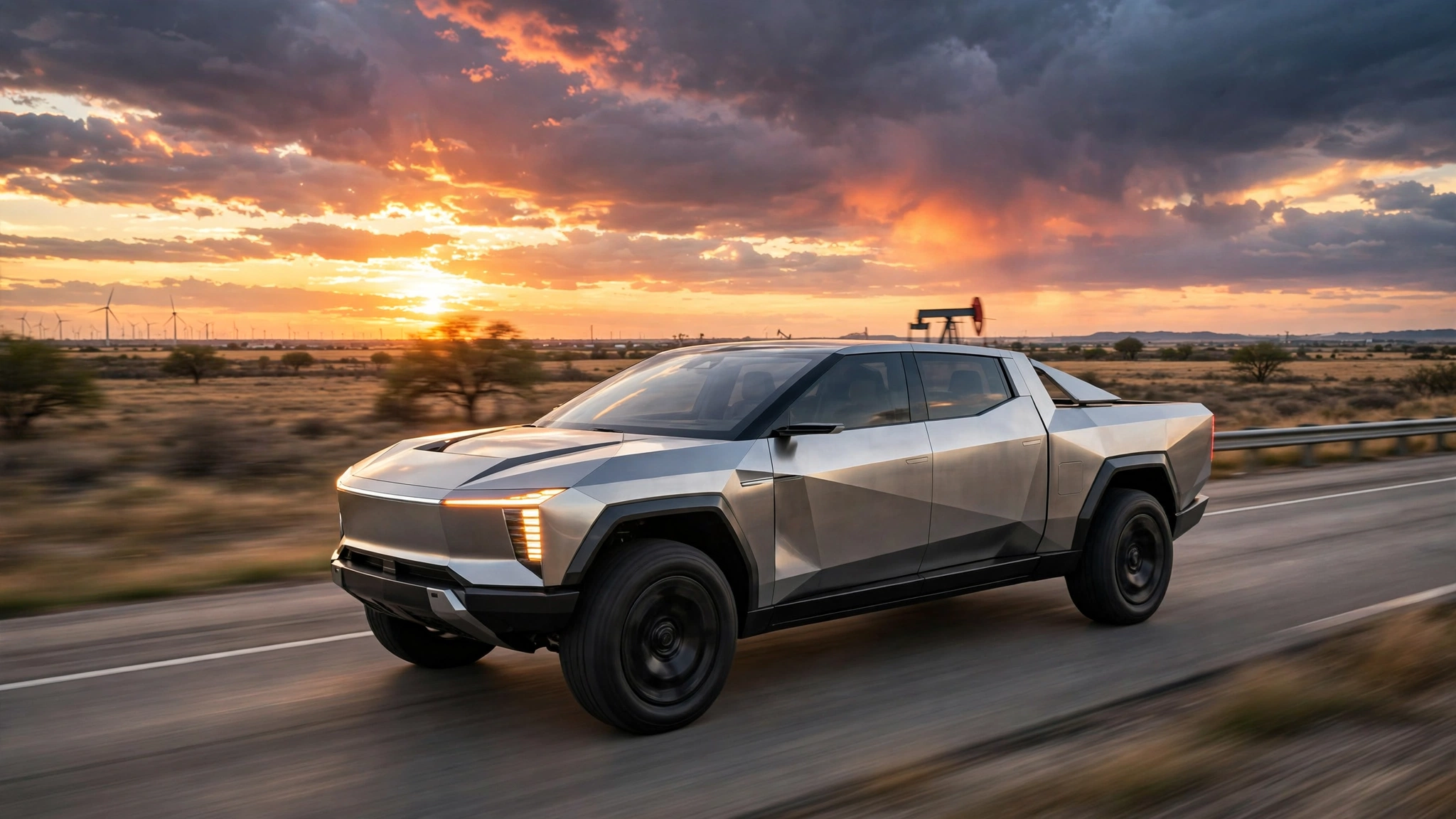
Tesla will wind down production of the Cybertruck at its Gigafactory Texas plant around the middle of 2027, chief executive Elon Musk announced on Friday, bringing an early end to one of the most talked-about vehicles in the company’s history. The factory space will instead be used to build more of Tesla’s Cybercab robotaxi.
“Tesla will be winding down production of the Cybertruck at Gigafactory Texas around the middle of next year to make room for increased Cybercab production,” Musk wrote in a post on X on November 6.
If production ends as planned, the Cybertruck will have been on sale for only about three and a half years. Customer deliveries began in late 2023 after years of delays, and the angular stainless-steel pickup generated enormous attention long before it reached the road.
Why Tesla is ending Cybertruck production
The official reason is capacity for the Cybercab, Tesla’s purpose-built autonomous vehicle. But the numbers tell their own story: the Cybertruck has sold at roughly a tenth of the volume Tesla built its production line for.
The Gigafactory Texas line was designed to produce 250,000 Cybertrucks a year. According to Kelley Blue Book, Tesla sold 16,097 Cybertrucks in the first nine months of 2025, a 38 percent drop from the 25,974 sold in the same period of 2024. Separate estimates cited by Reuters put total 2025 sales at 20,237, down 48 percent from 38,965 in 2024.
Sales fell sharply even as Tesla cut prices and offered incentives. The truck’s polarising design, high price, and quality complaints limited its appeal beyond a core group of enthusiasts, and it never became the mass-market pickup Tesla had promised.
Musk did not say whether Cybertruck production would move to another factory or whether the model would be discontinued altogether. He also did not say what would happen to outstanding orders or to the workers who build the truck at Gigafactory Texas, the only plant that makes it.
What the Cybercab means for Tesla
The Cybercab is a two-seat vehicle with no steering wheel or pedals, unveiled in October 2024 as the centrepiece of Musk’s plan to recast Tesla as an artificial intelligence and robotics company rather than a carmaker.
Tesla began building the Cybercab at Gigafactory Texas in April 2026 and started offering paid rides with a small fleet in Austin in September. Musk has said the company will eventually build more Cybercabs than all of its other vehicles combined, using a new “unboxed” manufacturing process designed to produce one vehicle every 10 seconds.
The bet is far from certain. The US National Highway Traffic Safety Administration launched an investigation into the Cybercab in September 2026, and Tesla has had to answer a special order demanding it prove, under oath, that the vehicle meets federal safety standards.
Full self-driving technology has also taken longer than Musk predicted. Tesla has been promising fully autonomous driving for more than a decade, and the Cybercab’s success depends on the company finally delivering it at scale.
A short, dramatic history
The Cybertruck was unveiled in November 2019, when Musk demonstrated its supposedly unbreakable windows on stage, only for the glass to crack in front of a live audience. Production was originally planned for 2021 but was repeatedly delayed, and customer deliveries did not begin until late 2023.
When it finally arrived, the truck divided opinion like few vehicles before it. Supporters praised its futuristic design and engineering, including the stainless-steel body and steer-by-wire system. Critics called it impractical, expensive, and hard to repair. It found a niche among enthusiasts but never broke into the mainstream pickup market dominated by Ford, General Motors, and Ram.
Last month, Tesla told reservation holders in Australia and New Zealand that the Cybertruck would not be built for either market and that their deposits would be refunded, an early sign that the model’s future was in doubt.
Reaction inside Tesla
Wes Morrill, the Cybertruck’s lead engineer, responded to Musk’s announcement with a reflective post, writing that “Cybertruck was an incredible technology development platform and lives on through Cybercab.” Several technologies developed for the truck, including its 48-volt low-voltage architecture, steer-by-wire system, and Etherloop wiring, have been carried over to the Cybercab.
The decision marks the second time this year that Tesla has ended a vehicle line to free up space for autonomy-related work, after the Model S and Model X earlier in 2026.
For Cybertruck owners, questions remain about long-term parts availability and resale values. Tesla has not announced a final edition of the truck or changes to aftersales support for existing vehicles.
Shoppers who still want one have until roughly mid-2027 to place an order. After that, the Cybertruck’s short, dramatic run will be over, and Tesla’s future will rest on whether the robotaxi bet pays off.