
Melania Trump Secures Oleshky Ceasefire for Aid Access
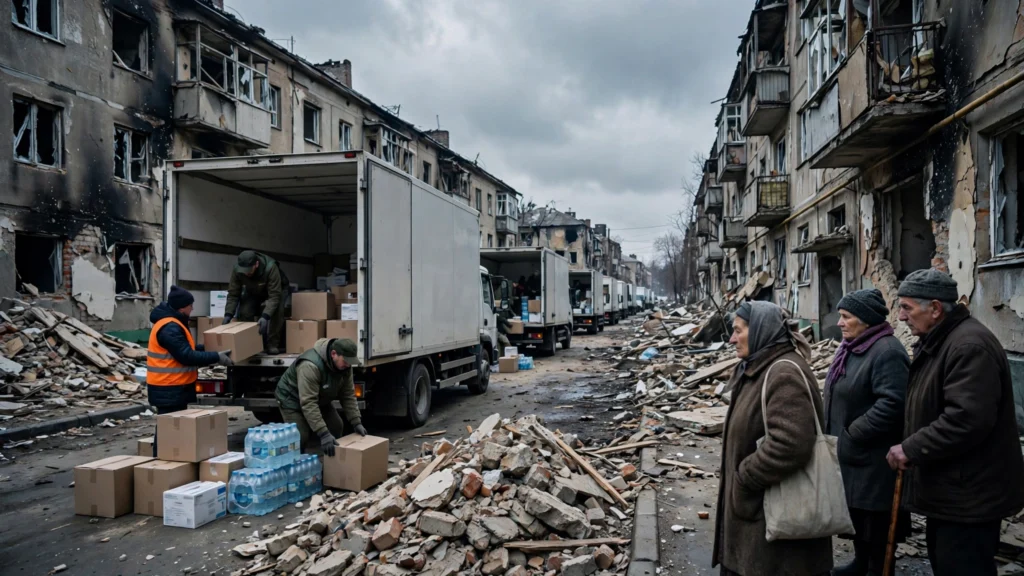
The Oleshky ceasefire announced on Friday marks an unusual diplomatic intervention: U.S. First Lady Melania Trump says she brokered a localized truce between Russia and Ukraine in the besieged city of Oleshky, where residents have been trapped and running out of food.
According to a statement from her office, the ceasefire will allow humanitarian aid to enter the Russian-occupied city and let residents who wish to leave evacuate to either Ukraine or Russia. The White House said the truce would begin on October 29, while Russian military officials said their forces would halt fire from 4 a.m. local time on October 27.
Both sides confirmed the agreement on Friday, according to Reuters, making it one of the rare moments of cooperation in a war that has lasted more than four and a half years.
A city on the brink of disaster
Oleshky sits on the left bank of the Dnipro River in Ukraine’s Kherson region and has been occupied by Russian forces since the first days of the full-scale invasion in February 2022. Residents have described constant shelling, a single hospital operating only a few days a week, malnourished children and people eating garden weeds to survive.
Ukraine’s foreign minister has called the situation a “full blockade,” and the Kremlin acknowledged in September that the town faced a critical situation. Ukrainian authorities said around 1,700 civilians remain in the city, and supply routes for food and medicine have been blocked.
“The situation in Oleshky is dire. Oleshky is a front-line war city on the brink of disaster,” Melania Trump said in the White House statement. “It was abundantly clear that without my intervention, the possibility to bring humanitarian aid into the city and to evacuate the elderly would be impossible.”
How the Oleshky ceasefire was brokered
Melania Trump described herself as an “exclusive intermediary” in the talks, saying she worked directly with Ukrainian and Russian leadership to secure the terms. The Kremlin welcomed her “humanitarian” involvement, and spokesman Dmitry Peskov said she had made a significant contribution to coordinating the operation.
Peskov said the idea had been discussed in a recent phone call between Russian President Vladimir Putin and U.S. President Donald Trump. Russia’s army chief, Valery Gerasimov, said on the Defense Ministry’s Telegram channel that Russian troops would halt fire to allow the humanitarian operation to start.
Under the terms described by both sides, civilian, non-military officials from Russia and Ukraine will visit residents at home to assess what help they need. Residents who choose to leave will receive coordinated support and transportation to their preferred destination.
“Oleshky’s remaining population is comprised primarily of elderly residents who urgently need medical attention, medicine, food, and clean water,” Melania Trump said. “The people of Oleshky have limited electricity, live amid mined roads, and endure regular military attacks.”
A year of quiet diplomacy
The announcement comes a year after Melania Trump revealed she had established a channel of communication with Putin to reunify children separated from their parents by the war. That earlier effort drew international attention because it placed the first lady in a direct diplomatic role rarely seen for a presidential spouse.
The Oleshky intervention extends that role. Unlike the children initiative, which involved quiet back-channel communication, the ceasefire announcement was public and specific, with dates, terms and confirmations from both capitals.
It also comes as President Trump steps up efforts to end the war, an approach that has alarmed Kyiv in recent weeks. His administration has pivoted back toward Moscow and away from Ukrainian President Volodymyr Zelenskyy, according to reporting on the diplomatic shift, and a dispute over access to the Starlink communication system used by Ukraine added to tensions.
What happens next in Oleshky
The immediate test is whether the ceasefire holds. The White House gave October 29 as the start date, while Russian officials pointed to October 27, a discrepancy that may reflect different phases of the operation or simply different time zones and military orders. The Kremlin said the evacuation itself was expected to take at least several days.
Aid agencies and observers will be watching several things:
- Whether humanitarian convoys can actually enter the city and reach residents
- Whether civilians who want to leave are allowed to do so freely, in both directions
- Whether the truce holds beyond the initial evacuation period
- Whether the model can be repeated in other besieged towns
For residents, the stakes are immediate. Another harsh winter is approaching, and the city faces death from hunger or disease if supplies do not arrive, according to reporting on conditions there.
Peace talks on the horizon
The ceasefire announcement coincided with news of broader diplomacy. Zelenskyy said negotiators from Ukraine, Russia and the United States had agreed to technical-level meetings in the first half of November in Abu Dhabi, and a U.S. official said the three countries may hold talks in a couple of weeks in Abu Dhabi or Switzerland.
Zelenskyy said he hoped a meeting of the countries’ leaders would follow. The peace efforts follow a rift between Washington and Kyiv and a series of moves by Trump seen as favoring Russia, including pressure on Ukraine over the Starlink system. Trump said on Friday that if Ukraine still faced a problem accessing the system, he would straighten it out and, if necessary, speak to SpaceX chief executive Elon Musk.
Whether the Oleshky deal builds momentum for a wider settlement remains uncertain. Local ceasefires have been agreed before in this war and have sometimes collapsed. But the involvement of the U.S. first lady, and the public confirmation from both sides, gives this one unusual political weight.
Why this ceasefire matters
Humanitarian ceasefires are among the hardest agreements to reach in war, because they require both sides to trust that a pause will not be exploited for military advantage. That both Moscow and Kyiv confirmed the Oleshky deal within hours suggests a genuine, if narrow, convergence of interests: neither side benefits from images of starving civilians in a town the world is now watching.