
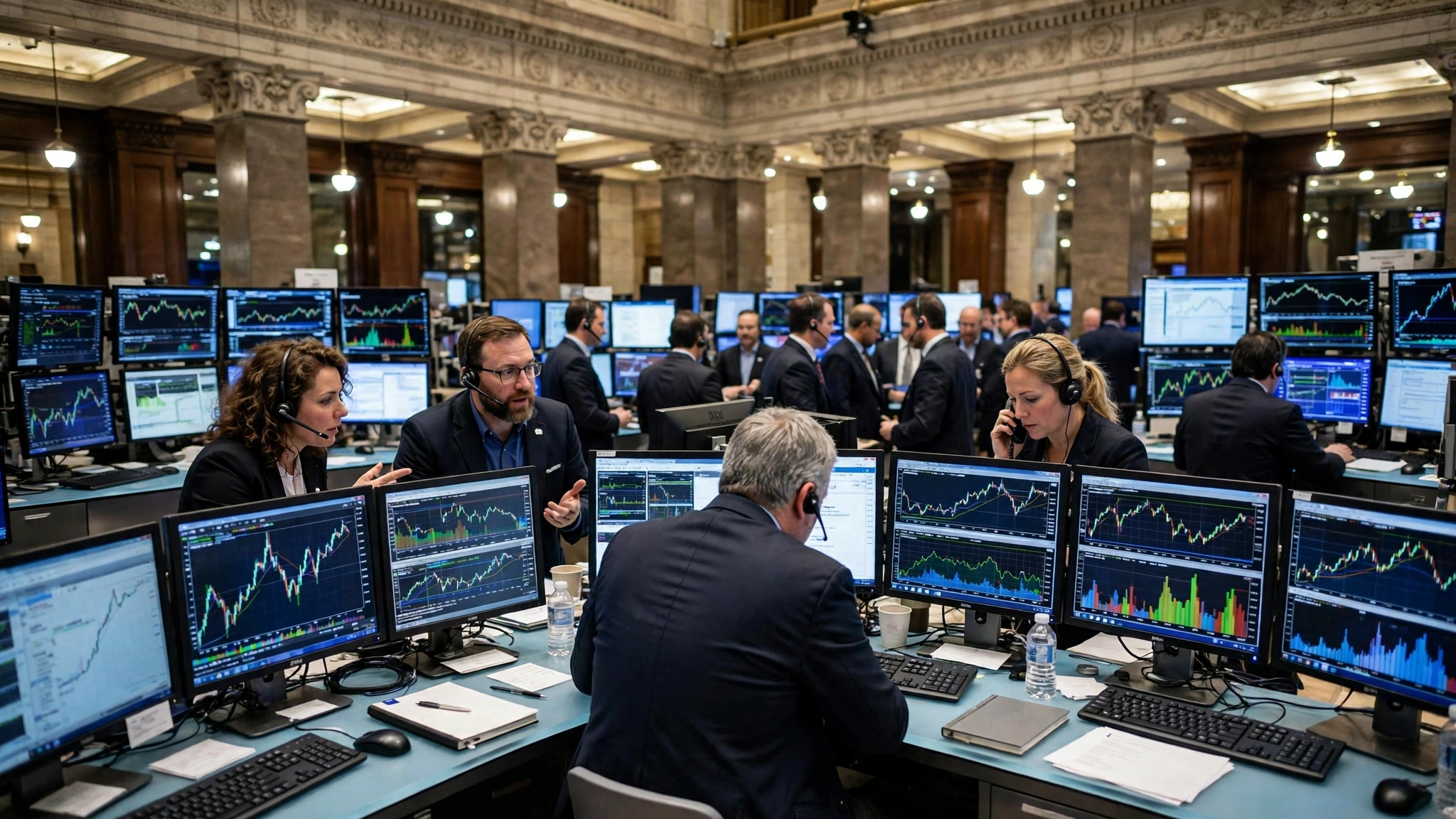
Wall Street staged its biggest post-midterm rally in 44 years on Wednesday, as the Dow Jones Industrial Average surged 1,569 points after voters handed Democrats control of both chambers of Congress — a result traders read as a brake on the war with Iran, on runaway oil prices and on the political uncertainty that had hung over markets for months. The Dow surges 1569 points rally was the index’s best single day since April 2025.
The Dow jumped 1,569.40 points, or 3.03 percent, to close at 53,356.12, moving above the 53,000 mark for the first time since September 8. It was the index’s biggest gain on the day after a midterm election since 1982, according to data from CFRA Research, and the fifth-largest one-day points gain in the history of the blue-chip index, Investopedia reported. The S&P 500 rose 1.58 percent to 7,688.62, and the Nasdaq Composite gained 1.44 percent to 25,736.51.
The rally gathered further momentum as crude oil prices slumped more than 8 percent, providing additional relief to investors concerned about inflation and energy costs. Brent crude, the international benchmark, fell almost 8.7 percent and settled at $94.62 a barrel, its lowest settlement since August 31, according to CNN. US West Texas Intermediate crude fell more than 8 percent to $88.12 a barrel.
Oil plunges on hopes of an end to the Iran war
If the stock market’s rally was striking, the move in oil was just as dramatic, and the two were closely linked. Brent crude dropped below $100 a barrel for the first time in nearly a month, and Reuters reported on Thursday morning in Asia that it had fallen by about 20 percent so far in the week. If that decline is sustained through Friday’s close, it would be the largest weekly drop in oil prices since a week in April 2020, when United States crude briefly fell into negative territory.
Traders bet that the Democratic sweep could hasten an end to the US-Iran war, which began in late February 2026 when the United States and Israel attacked Iran. Vice President JD Vance fuelled that bet on Wednesday, writing on X that the war was the reason Republicans lost the midterms — a public break with President Trump that markets read as a sign the administration’s appetite for further escalation is fading.
Brent had already been under pressure, and in early Asian trading on Thursday it was testing its overnight lows near $93.50, according to Reuters. The most important number of the day, some analysts argued, was not the Dow’s 1,569 points but Brent crude’s fall to $94.62, because cheaper oil eases the inflation pressures that have shaped the Federal Reserve’s decisions all year.
Gold, bonds and the dollar
Gold climbed about 3 percent on Wednesday as the dollar slid, lifting demand for bullion. December gold futures settled up 3.37 percent at $4,073 an ounce, the metal’s biggest daily gain since mid-August, and spot gold was trading around $4,135 in early Thursday trading. Silver surged 5.08 percent.
The dollar index fell 0.34 percent to 101.22, and the yield on the benchmark 10-year Treasury note dropped to about 4.85 percent, its lowest in nearly two months. Markets are still pricing in a high probability that the Federal Reserve will raise interest rates by a quarter point at its December meeting, although Citi has argued that a lasting reopening of the Strait of Hormuz could turn the Fed from hikes to cuts.
The Bank of England was also in focus on Thursday, with markets expecting the first hike of its cycle, by 25 basis points to 4 percent, after rising energy costs pushed up UK inflation.
Data-centre stocks tumble
Not every corner of the market shared in the rally. Data-centre stocks fell sharply as investors weighed the election results, after voters rejected AI data centres in nearly every local ballot measure where the issue appeared. Texas elected Democrat Gina Hinojosa as governor after she promised tougher rules for data centres, and the prospect of tighter regulation and slower infrastructure expansion weighed on the sector.
The rotation was the mirror image of the AI trade that has dominated markets for much of the year. Investors moved out of the infrastructure names that had powered the rally and into the broader market, betting that cheaper energy and a divided government would favour the economy as a whole rather than a single theme.
What the rally does and does not mean
The scale of Wednesday’s move reflects relief as much as optimism. A clear election result removed months of political uncertainty, and the prospect of divided government — a Democratic Congress and a Republican White House — has historically been welcomed by markets, which read it as a brake on sweeping policy change in either direction.
But analysts warned that the forces behind the rally could reverse quickly. The war in Iran is not over, and a single election result does not end it. Democrats have warned that their main bargaining chip could be a fight over the debt ceiling in 2027, which markets dislike, and the new majority’s subpoena power means months of investigations into the administration lie ahead.
For now, though, Wall Street has spoken. The Dow’s best post-midterm day since 1982, oil below $100 for the first time in a month, and gold at its highest in two weeks all point the same way: investors believe the election changed the direction of American politics, and they are betting that cheaper energy and calmer politics will follow.