
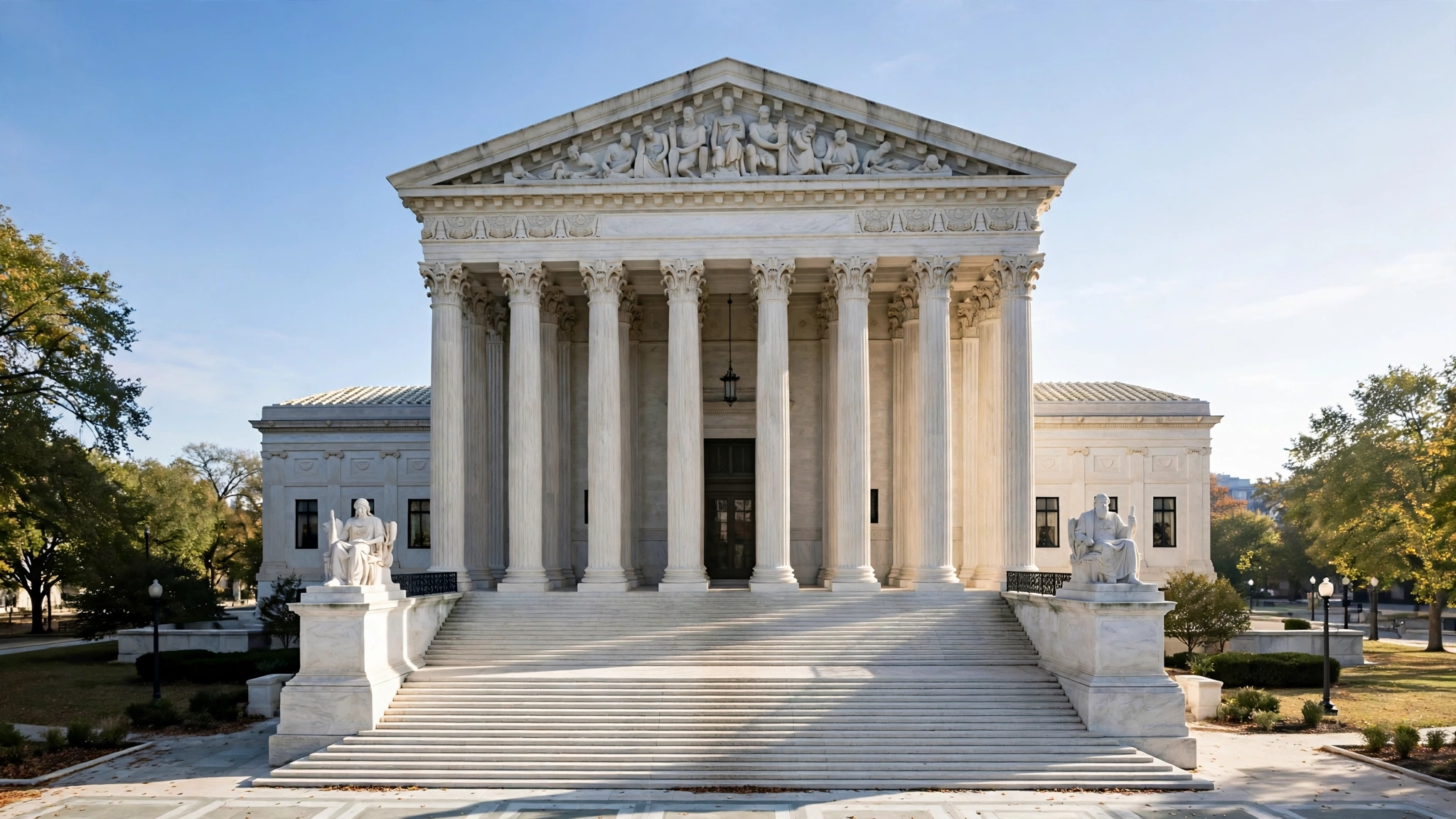
The Supreme Court will hear arguments on Monday, November 9, in a case that could end lawsuits against federal agents, including officers of Immigration and Customs Enforcement (ICE), for alleged violations of the Constitution. The case, Nielsen v. Watanabe, gives the court’s 6-3 conservative majority an opportunity to eliminate what remains of a 55-year-old precedent that allows people to sue federal officers for money damages.
The plaintiff is Kekai Watanabe, a federal prisoner who says he was attacked during a gang-related fight at a prison in Honolulu in 2021 and then denied proper medical care. He is seeking $3 million in damages from Francis Nielsen, a federal prison nurse, saying she should have hospitalized him or sent him to a specialist after the attack, which he says left him with a broken tailbone and excruciating pain.
Decades of Supreme Court decisions have already narrowed the ability to seek damages from a federal employee accused of violating someone’s constitutional rights. Depending on the outcome of Monday’s hearing, such suits could be blocked entirely, according to USA TODAY, which reported on the case on Sunday.
The Bivens precedent under threat
The ability to sue a federal officer for money damages comes from a 1971 Supreme Court decision, Bivens v. Six Unknown Named Agents, which allowed a man to sue federal narcotics agents who searched his apartment and arrested him without a warrant. The court held that a claim for damages could be inferred directly from the Fourth Amendment, even though Congress had never passed a law authorizing such suits.
The court extended that remedy only twice: in 1979, for sex discrimination by a member of Congress, and in 1980, in Carlson v. Green, for a prisoner denied medical care. Since 1980, the court has not ruled in favor of a Bivens claim. In its most recent decision on the issue, Egbert v. Boule in 2022, the court noted it had “declined 11 times to imply a similar cause of action” and said that “in all but the most unusual circumstances, prescribing a cause of action is a job for Congress, not the courts.”
Watanabe’s case is closely modeled on Carlson v. Green. Like that case, it involves an Eighth Amendment claim for cruel and unusual punishment based on the denial of medical care to a prisoner. An appeals court ruled that his claim passes the court’s test, finding it identical to the 1980 decision, in which the justices said federal prison staff violated the Eighth Amendment when they failed to respond appropriately to a prisoner’s fatal asthma attack.
What the Justice Department argues
The Justice Department, which is defending the nurse, argues that the 1980 decision is now “obsolete” because of the more recent Supreme Court rulings limiting the reach of Bivens claims. The government contends that the court should not allow Watanabe’s suit to proceed, and the case gives the justices a chance to go further and overrule what is left of Bivens altogether.
Several conservative justices have called for Bivens to be overruled outright. They argue that the then-liberal court in 1971 used the decision to grant rights that are not spelled out in the Constitution, and that creating a right to sue is a job for Congress, not the courts.
Supporters of the limits say the separation of powers requires Congress to decide when federal officers can be sued. Critics of that view argue that Congress has never created such a remedy, and that without Bivens, people harmed by federal misconduct would have no way to seek compensation at all.
Why the case matters for ICE accountability
The case has taken on special significance amid calls to hold immigration agents and other federal officers accountable, according to Erwin Chemerinsky, dean of the law school at the University of California, Berkeley. “If Bivens is eliminated, then there’ll be literally no way to sue in federal court when a federal agent like ICE violates the Constitution,” he said.
The issue is not abstract. If state or local officers violate the Constitution, they can be sued under a federal statute, 42 U.S.C. Section 1983. But no federal law authorizes suits against federal officers for constitutional violations. Bivens is the only route.
Chemerinsky and other legal scholars note that the debate comes as public attention focuses on the conduct of federal immigration agents, including the fatal shootings of Renee Nicole Good and Alex Pretti. Those cases have intensified demands for accountability, and the outcome in Nielsen v. Watanabe will shape whether civil lawsuits remain available as a tool for it.
What happens next
The justices will hear oral arguments on Monday, November 9. A ruling is expected in the coming months, before the court’s term ends. The decision could take several forms: the court could allow Watanabe’s claim to proceed under Carlson v. Green, it could reject his claim while leaving Bivens technically intact, or it could overrule Bivens entirely.
A ruling that ends Bivens would close the last remaining path for damages suits against federal officers, leaving Congress as the only body that could create a new remedy. Critics of that outcome are urging Congress to pass a federal equivalent of Section 1983, which would give people an explicit statutory right to sue federal agents.
For now, the case stands as one of the most consequential of the court’s term. It began as a dispute over medical care for one prisoner in Hawaii, but its outcome could determine whether millions of Americans have any legal recourse when a federal agent violates their constitutional rights.