
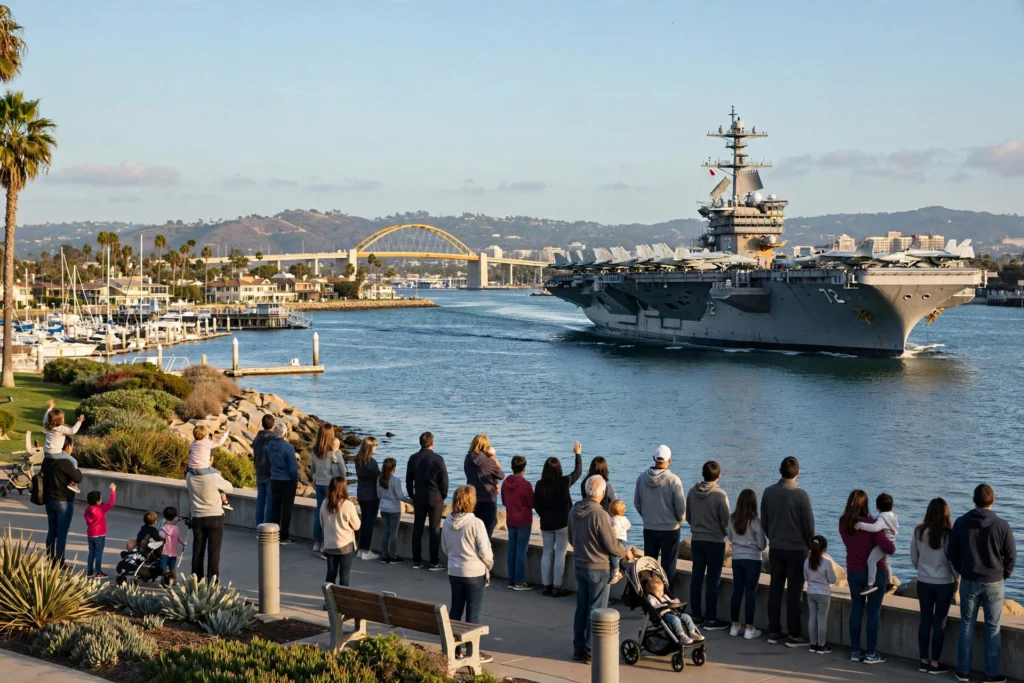
USS Abraham Lincoln Returns After 322-Day Deployment
The USS Abraham Lincoln returns to its home port in San Diego after one of the longest carrier deployments of the modern era, ending a 322-day assignment that included a record stretch at sea supporting US operations in the war on Iran. The nuclear-powered aircraft carrier arrived at Naval Air Station North Island on Thursday, where families and friends gathered on the pier to welcome nearly 5,000 service members home, according to Associated Press reporting carried by NPR member stations.
The homecoming closed a deployment that began last November and kept the ship and its air wing away for more than ten months. The Lincoln was relieved in the Middle East by the USS George Washington before making the transit home, The Week reported in its summary of the return.
USS Abraham Lincoln returns after a record run at sea
During the deployment, the Lincoln spent 265 consecutive days at sea without a port call, a post-Vietnam War record for uninterrupted time underway, before a brief stop in Thailand in early September, according to AP and Al Jazeera reporting. The total deployment of 322 days was just short of the 326-day deployment completed earlier this year by the USS Gerald R. Ford, which AP described as the longest for an aircraft carrier in the past 50 years.
Navy officials said the Lincoln is the second carrier to endure an unusually long deployment during the Iran war and to receive the Presidential Unit Citation afterward, an award typically associated with significant achievement in combat, according to the AP account. The citation reflects the operational tempo the carrier strike group maintained during its time in the region.
- Total deployment: 322 days
- Consecutive days at sea: 265, a post-Vietnam record
- Home port: Naval Air Station North Island, San Diego
- Crew size: nearly 5,000 service members, including the embarked air wing
Families reunite on the pier
By long-standing naval custom, new fathers were among the first to disembark. AP reported that 64 sailors from the ship’s company met their babies for the first time on the pier, and that with the air wing included, there were 122 new fathers in total. A ceremonial first kiss, another homecoming tradition, was also held before general disembarkation.
Reporters on the pier described emotional reunions as sailors scanned the crowd for family members. Relatives held handmade signs and flags along the quay, and many families said they were looking forward to ordinary routines again: home-cooked meals, time off, and catching up on milestones missed during the deployment.
The length of the deployment shaped those reunions. Children born while the ship was underway were already several months old by the time their parents stepped ashore. For spouses and partners who managed households alone through the deployment, the return marked the end of a long stretch of uncertainty about schedules and conditions at sea.
Conditions during a long deployment
Extended carrier deployments place heavy demands on crews. Months without a port call mean limited time off the ship, long working days in support of flight operations, and extended separation from family. AP’s reporting noted that returning sailors spoke about relief at being home and about plans to take leave and spend time with family after the intense operational period.
The Navy has in recent years faced recurring questions about how to sustain readiness during long deployments while protecting crew wellbeing and retention. Very long deployments can help maintain a continuous presence in a crisis region, but they also increase wear on equipment and strain on sailors and families, issues the service continues to study after each major homecoming.
Strategic backdrop
The Lincoln’s deployment unfolded against the US-Israel war on Iran, during which US naval forces maintained a large presence in and around the Middle East. Carrier strike groups provide air power, missile defense support and a visible deterrent, and they can surge aircraft for strike or defensive missions without relying on host-nation bases.
With the Lincoln now home, the Navy will rotate the ship into a maintenance and training period while other carriers cover overseas commitments. The handover to the USS George Washington in the Middle East was intended to keep a carrier presence in the region even as the Lincoln began its journey home, according to The Week’s account.
What happens next for the crew
In the days after a homecoming, sailors typically take block leave in rotations, reunite with extended family, and begin the process of resetting after deployment. The ship itself enters a period of upkeep, repairs and inspections after months of continuous operations.
For San Diego, a major Navy town, the return of a carrier is both a civic moment and an economic one, as thousands of sailors return to local neighborhoods and businesses. For the families on the pier on Thursday, though, the focus was simpler: a deployment that set records for time at sea had finally come to an end, and the USS Abraham Lincoln was home.
Pingback: Pentagon to Livestream Fort Hood Firing Squad Execution
Pingback: Lindsay Clancy Court: Gag Order Sought as She Returns