
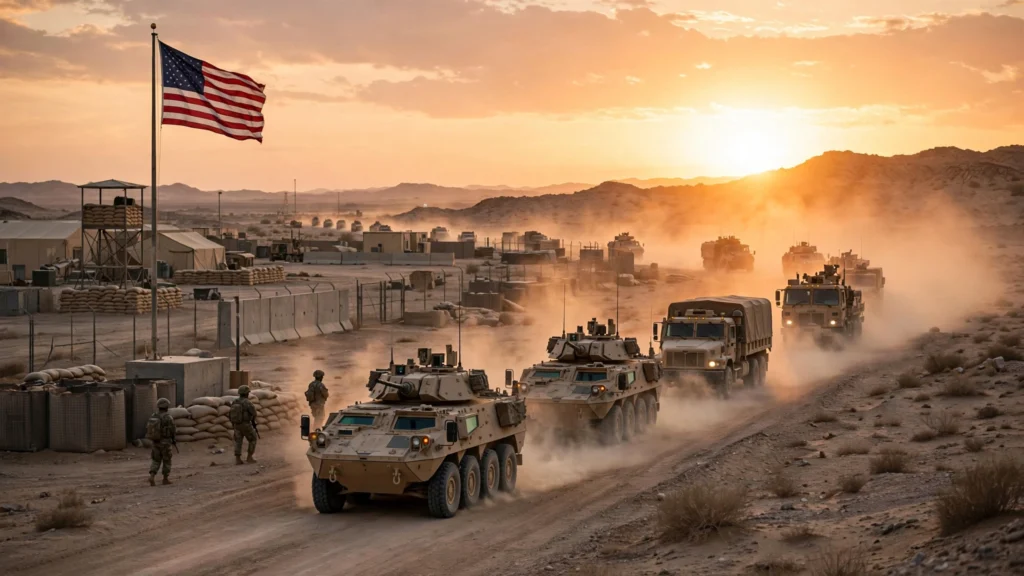
US Troops Iraq Withdrawal: Last Bases Empty by September 30
BAGHDAD — The US troops Iraq withdrawal is entering its final hours, with American forces set to pull out from their last bases in Iraq by Wednesday, September 30, closing the book on more than two decades of US military presence in a country where 4,500 Americans died, Reuters reported Tuesday.
The departure, agreed in 2024 under then-President Joe Biden and carried out by President Donald Trump’s administration even as Washington wages war against Iran, is being celebrated as a victory by Tehran and its allies, who now wield deep influence across Iraq, according to Reuters reporting from Baghdad.
US Troops Iraq Withdrawal: What the Agreement Covers
The drawdown stems from an agreement reached in 2024 to end the US-led coalition’s combat mission in Iraq. Under that deal, American forces are leaving their remaining positions this week, marking the formal end of an American ground footprint that has defined Iraqi politics and security for a generation.
The timing is striking: the final pullout is happening while the Trump administration is conducting a war against Iran, a conflict that has reshaped the region’s security calculus and made the American presence in Iraq a target of Tehran-aligned factions for years.
US officials have not publicly detailed how many troops remain at the last bases or where repositioned forces will go next, but Iraqi security experts told Reuters the departure removes a military presence that for years acted as a counterweight to Tehran’s influence in Iraq.
Why Iran and Its Allies Are Celebrating
Iran-backed groups are openly framing the exit as a historic triumph. Abu Mojtaba al-Yasiri, a commander in the Islamic Resistance in Iraq, an umbrella group of Iran-aligned armed factions, described the US withdrawal as “a historic victory for the Iraqi Islamic resistance groups and honorable Iraqis, and a crushing defeat for the American project,” in comments to Reuters.
“On September 30, we will celebrate the turning of a black page in Iraq’s history and the failure of the occupation to impose its will on our country,” al-Yasiri said. “Iraq has proven that its sovereignty cannot be secured by foreign forces, but by the resistance and the will of its people.”
Analysts say the celebrations reflect a strategic reality. “Iran stands to benefit strategically from the coalition’s departure because it removes a military presence that for years acted as a counterweight to Tehran’s influence in Iraq,” Jasim al-Bahadli, an Iraqi security analyst specializing in armed Shi’ite groups aligned with Iran, told Reuters. He predicted pro-Iranian militia groups would “seek to translate that momentum into greater influence over security and political decision-making.”
What Security Experts Fear Comes Next
Not everyone in Baghdad is cheering. While the eventual departure of US forces is broadly popular among Iraqis, those who worry about the strength of Iran-backed groups fear the withdrawal is premature, Reuters reported.
Iraqi security experts warn the exit could give Tehran and its powerful allies free rein in the country, while also allowing other US adversaries to stage a comeback — including the Islamic State, the extremist group whose resurgence the US-led coalition spent years fighting.
Key concerns raised by analysts include:
- Power vacuum: With coalition forces gone, Iran-aligned militias may deepen their control over security institutions and political decision-making.
- Extremist resurgence: The Islamic State retains the ability to exploit instability, and experts warn the group could attempt a comeback without US intelligence and airpower in the region.
- Regional spillover: The withdrawal is unfolding during an active US war with Iran, raising the stakes of any miscalculation by armed factions inside Iraq.
Two Decades of War, in Brief
The American military story in Iraq spans more than twenty years and multiple phases: invasion, occupation, counterinsurgency, withdrawal, return, and a long-running campaign against the Islamic State. Across those two decades, 4,500 American service members died, according to Reuters.
For Iraqis, the human and material costs were vastly greater, and the American presence remained a central grievance for armed factions that cast themselves as a resistance to foreign occupation. That narrative — now claimed as vindicated by groups like the Islamic Resistance in Iraq — is likely to shape Iraqi politics for years.
Whether the departure marks a genuine turning point toward Iraqi sovereignty or the start of a darker chapter under heavier Iranian influence is the question now hanging over Baghdad. What is certain is that on September 30, the last American convoys will roll out — and a new era in Iraq, defined by the absence of US troops, will begin.