
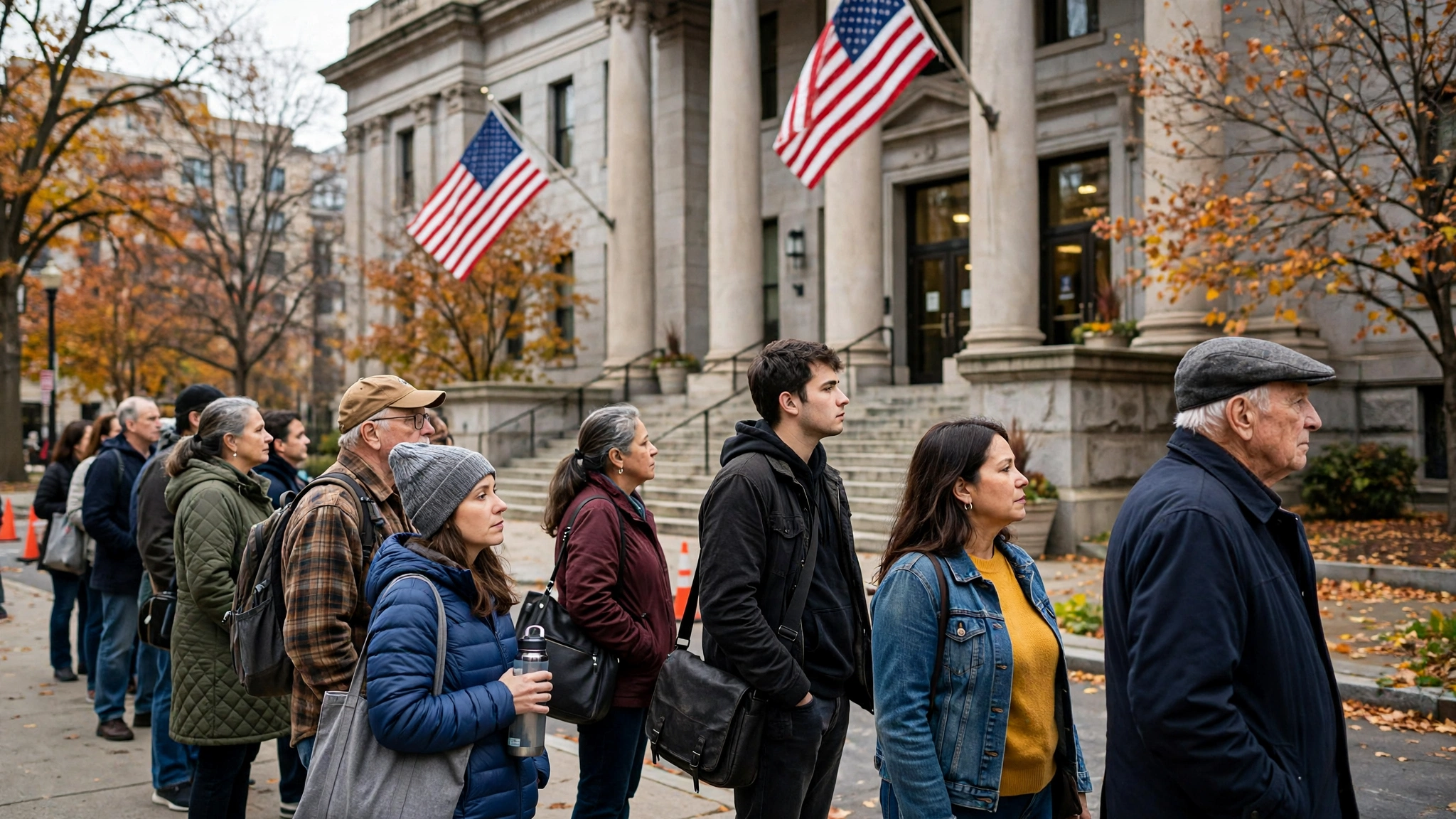
Americans are voting across the country on Tuesday, November 3, in the 2026 midterm elections, a contest that will decide control of Congress for the final two years of President Donald Trump’s second term. The 2026 midterm elections put all 435 seats in the House of Representatives, 35 seats in the Senate and governorships in 36 states on the ballot, along with thousands of state and local races.
Polling places opened early on the East Coast, with the first sites opening just after 6 a.m. Eastern time in states including Vermont, New York, New Jersey, Virginia and Kentucky, according to live election coverage. Polls close in waves across the country through the evening, with the first closings at 6 p.m. Eastern in parts of Indiana and Kentucky and the final polls closing at 1 a.m. Eastern in Alaska’s Aleutian Islands.
More than 230 million Americans are eligible to vote in the midterms, and early voting had already drawn tens of millions of ballots before Election Day. Reports put the early total at more than 53 million by November 1, and some counts put it above 57 million, a pace that election watchers said was ahead of the previous midterm cycle. Early votes do not show how people voted, and officials have stressed that results will take time in states where mail ballots are still arriving.
What is at stake in the 2026 midterm elections
Republicans currently hold both chambers of Congress, with a narrow 218-214 majority in the House and a 53-47 majority in the Senate, according to Reuters and other election guides. Democrats need a net gain of only a few seats in the House to take control, while in the Senate they need a net gain of four seats, because a 50-50 tie would leave Republicans in charge through the vice president’s tie-breaking vote.
The Senate map is uneven: Republicans are defending 22 of the 35 seats on the ballot, while Democrats are defending 13. The 35 seats include 33 regular contests and two special elections, in Florida and Ohio, to fill seats vacated when their holders joined the administration. Analysts have pointed to competitive Senate races in states including Georgia, North Carolina, Ohio, Iowa, Maine and Kansas as contests that could decide the chamber.
In the House, forecasters have described as many as 16 toss-up races as potentially decisive, with the Cook Political Report rating 53 House races as competitive. The governor races add another layer: 36 states are choosing governors, and races in Kansas, Nevada and Georgia have been rated as pure toss-ups.
How Election Day voting works
Election rules are set by each state, so poll hours, identification requirements and mail-ballot deadlines vary widely. Voters who are in line when polls close are still entitled to vote, and voters whose names are not on the rolls can ask for a provisional ballot, which officials check afterwards. State and local election offices, along with the official Can I Vote tool, are the authoritative sources for a voter’s polling place and ballot.
Because voting is largely by mail in states such as California and Washington, full results there may take days. California counts ballots postmarked by Election Day if they arrive by November 10, and Washington’s deadline is November 23, according to election coverage. In many other states, most counting is expected to finish on election night, although close races may still require recounts or further checks.
- All 435 House seats are on the ballot in the 2026 midterms.
- Thirty-five Senate seats are contested, including two special elections.
- Thirty-six states are electing governors, and 145 statewide ballot measures are also on ballots.
- Early voting topped 53 million ballots by November 1, according to election trackers.
The issues shaping the vote
Both parties have framed the midterms as a referendum on the direction of the country. Republicans have urged supporters to turn out in large numbers to protect the president’s agenda, while Democrats have argued that the vote is a check on that agenda, pointing to the economy, the war with Iran and immigration enforcement as central issues. President Trump told supporters at closing rallies in Iowa and Kansas that Republicans had given the midterms “a very strong shot,” while acknowledging that the president’s party usually loses seats in a midterm year.
The economy has featured heavily in campaign advertising, with a record $3.8 billion spent on political advertisements by mid-October, according to AdImpact figures cited by Reuters. Top spending has been concentrated in battleground Senate races in Texas, Ohio and Michigan. Polling averages ahead of Election Day showed Democrats with a mid-single-digit lead on the generic congressional ballot, although analysts cautioned that turnout and the geography of individual districts matter more than the national margin.
When results will be known
Results will arrive in stages through Tuesday night and into Wednesday. The first statewide winners cannot be declared until the last polls close in a state, and networks and election officials alike have warned that close contests may not be called on election night. In 2022, it took several days for control of the House to be settled, and officials have said a similar wait is possible this year.
What is certain is the scale of the decision: voters are choosing the lawmakers who will shape legislation, spending, oversight and confirmations for the rest of the presidential term. Whether Republicans keep both chambers or Democrats win one or both will determine how much of the administration’s programme can pass in its final two years, and how much scrutiny it faces from Capitol Hill.
For voters still heading to the polls, election officials advise checking the polling place before travelling, bringing any identification required by their state, and allowing extra time where weather or relocated polling places have changed local arrangements. Results coverage will continue as polls close across the country.
2 thoughts on “US Midterm Elections 2026: Voters Decide Congress Control”