
Trump Waives Russia Sanctions After Putin Diesel Deal
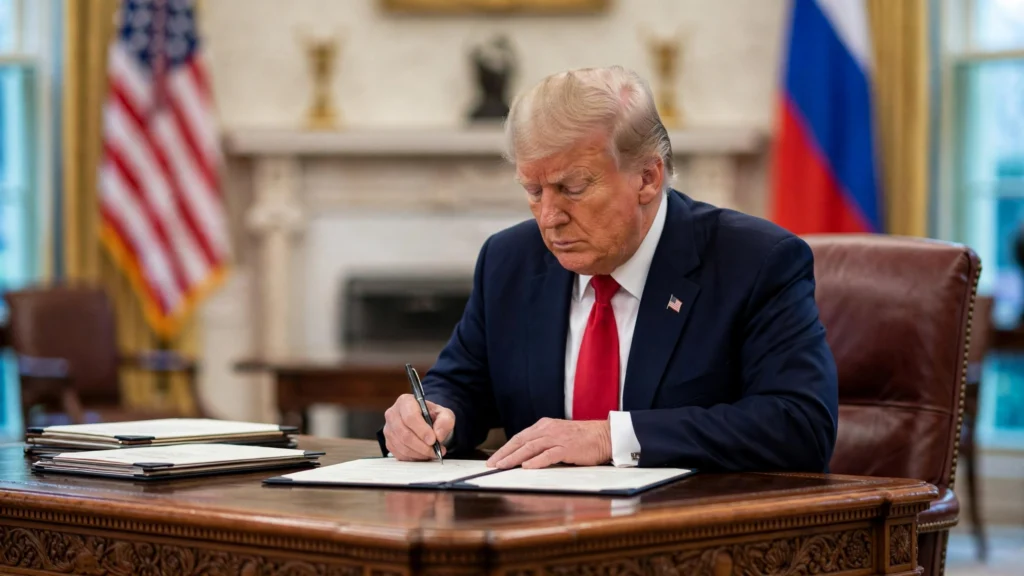
President Donald Trump on Friday signed an executive order waiving sweeping new sanctions and tariffs targeting Russia’s energy revenues, telling Congress that suspending the measures was in the national interest of the United States. The Trump Russia sanctions reversal came only weeks after he had signed the sanctions package into law and followed a deal with Russian President Vladimir Putin for Russian diesel shipments aimed at bringing down global energy prices.
According to multiple news outlets that reviewed the order, Trump formally certified to Congress that “the issuance of such a waiver at this time is in the national interests of the United States.” The waiver suspends the application of measures authorized by the Lindsey O. Graham Sanctioning Russia and Iran Act of 2026, which Congress passed with large bipartisan majorities and which Trump signed into law in early October.
What the Trump Russia sanctions waiver covers
The Graham Act — named after the late South Carolina senator who sponsored it — was designed to squeeze Russia’s economy over its war in Ukraine. It targeted Russia’s energy and defence industries, President Putin and other senior officials, and Moscow’s so-called “shadow fleet” of tankers used to move Russian oil while circumventing Western restrictions, according to reports on the legislation.
Crucially, the law gave the president authority to impose tariffs of up to 100 per cent on major buyers of Russian oil and gas, including countries such as India and China, if they continued those purchases after a specified deadline. Those tariffs were due to take effect on Sunday before Friday’s waiver removed the immediate threat of the duties.
Trump directed the US Trade Representative to continue monitoring countries’ purchases of Russian-origin crude oil and natural gas, as well as efforts to evade sanctions, leaving open the possibility that the measures could be reconsidered. The waivers will remain in effect until Trump or, where authorized, the Secretary of State determines that further action is necessary, according to reports on the order’s text.
The Putin diesel deal behind the reversal
The waiver followed Trump’s announcement of an arrangement with Putin under which Russia would supply diesel to help stabilize global energy markets. Trump said Russia had agreed to provide more than 300,000 tonnes of diesel immediately, with additional shipments expected in November and subsequent months.
Reports also indicated that the US Treasury Department issued a temporary licence to facilitate the deliveries, and that further shipments of 500,000 tonnes in November and an additional one million tonnes at a later stage were discussed under the arrangement. Trump linked the move to efforts to bring down fuel prices, a growing political concern ahead of the November 3 midterm elections.
The deal has raised alarm among European officials, who argue that easing restrictions on Russian energy exports could weaken Western efforts to limit Moscow’s revenues while the war in Ukraine continues. The decision also removed immediate pressure on India, which imports more than 88 per cent of its crude oil needs, with Russian oil accounting for 45 per cent of its total imports in August at 2.08 million barrels per day, according to the Indian Express. India’s foreign ministry said on Friday that its energy policy was guided by market availability and prevailing global circumstances.
Lawmakers condemn the move
Reaction in Washington was swift and bipartisan. Senator Richard Blumenthal, who helped draft the Graham Act, said Trump was turning his back on “the majority of Americans, their representatives in both houses of Congress, and our European allies.”
“These waivers have nothing to do with our national security, and everything to do with sucking up to Vladimir Putin. I hope my Republican colleagues will join me in condemning this craven, cowardly action,” Blumenthal wrote on X, according to the Hindustan Times.
Republican Representative Don Bacon criticized the decision, saying the president was “prolonging the war, not ending it.” Democratic Representative Don Beyer called the move Trump’s “latest surrender to Putin,” adding that it “defies clear congressional intent of legislation designed to punish Russia for its illegal war of aggression.”
From Moscow, a Russian presidential envoy, Kirill Dmitriev, called the suspension “an important and truly historic moment” on social media, according to Channel News Asia. The Kremlin itself had not formally reacted, but Putin appeared in military uniform on Friday and said Moscow intends to seize the rest of eastern Ukraine.
Ukraine tensions deepen
The sanctions waiver landed amid sharply worsening relations between Trump and Ukrainian President Volodymyr Zelensky. Zelensky has publicly criticized the diesel arrangement with Russia, while Trump has criticized the Ukrainian leader and questioned his leadership, according to multiple reports.
Zelensky urged European Union leaders this week to commit nearly $80 billion more to fund Ukraine’s fight next year, insisting he was standing up for his country as American support wavered. Asked by journalists in Brussels whether he was being made a scapegoat for Trump’s domestic troubles ahead of the midterms, Zelensky responded only with an extended smile and said, “This is my answer.”
What happens next
- The waiver suspends sanctions and tariff powers immediately; the administration says it will monitor Russian energy purchases and sanctions evasion.
- The diesel shipments are expected to begin flowing under a temporary Treasury licence, with more tranches due in November.
- Ukraine’s government and European allies are watching whether Washington’s position on Kyiv shifts further ahead of the midterms.
- Congressional critics may seek legislative ways to constrain the president’s waiver authority, though the law as written leaves the decision with Trump.
For now, the reversal marks one of the sharpest turns yet in Washington’s economic pressure campaign against Moscow — and a diplomatic win for Russia just as the war in Ukraine enters another winter.