
SpaceX Starship Flight 14 Reaches Orbit in Fiery Debut
SpaceX Starship Flight 14 made history on Monday, Sept. 28, becoming the first Starship mission to reach Earth’s orbit — then ended in a spectacular fireball over the Pacific Ocean, capping a dramatic three-hour flight that delivered the rocket’s first-ever operational payload.
The massive rocket lifted off from SpaceX’s Starbase facility in South Texas at 8:48 a.m. ET, powered by 33 engines on the Super Heavy booster. After more than three years of testing and 13 previous suborbital flights, Starship finally climbed to orbit — a milestone SpaceX chief executive Elon Musk celebrated as a major leap toward the Moon, Mars and beyond.
How SpaceX Starship Flight 14 reached orbit despite an engine failure
The mission nearly went wrong within minutes of liftoff. Shortly after Starship’s upper stage separated from the Super Heavy booster — which itself splashed down in the Gulf of Mexico — one of the ship’s six Raptor Vacuum engines shut down prematurely during the ascent.
“Ship did lose one of the engines, one of its R Vacs, it looked like, on the way uphill,” a SpaceX livestream host said about ten minutes after launch, according to Astronomy.com. Communications manager Dan Huot initially told viewers the team would skip the additional engine burn needed to reach orbit: “Because of that [engine failure], we are not going to do the additional burn that will send us into orbit.”
For the next ten minutes, Starship coasted while mission controllers pored over the flight data. Their analysis showed the remaining engines could still complete both the orbital insertion and, crucially, the deorbit burn needed to bring the ship home safely. At T+21:53, Huot delivered the revised verdict: “We are go for orbit.”
Starship settled into an orbit roughly 170 miles (275 kilometers) high and circled the planet twice — two laps instead of the six originally planned for a nearly 10-hour mission. Flight controllers shortened the flight to ensure the ship could be brought down safely on its reduced engine power.
The Starlink satellites onboard Flight 14
One of the mission’s headline achievements had nothing to do with the fireball. During its time in orbit, Starship deployed 26 next-generation Starlink V3 satellites one by one at an altitude of about 161 miles — the first operational payload the megarocket has ever carried, and the first revenue-generating mission for a vehicle still in development.
“All 26 Starlink V3 operational satellites deployed and operating nominally,” Musk wrote on X. The satellites are expected to raise their orbits and begin serving customers within weeks, SpaceX said. According to the New York Post, the 26 satellites together add about 26 terabits per second to the world’s total internet bandwidth — roughly a 1% increase in global capacity.
SpaceX had delivered test satellites on earlier Starship flights, including a batch on the previous test flight in July that intentionally burned up in the atmosphere. This time the cargo counts: the V3 satellites are the company’s most advanced yet.
The fiery ending over the Pacific
About three hours after liftoff, Starship reentered Earth’s atmosphere and descended toward a pre-designated landing zone in the northern Pacific Ocean, north of Hawaii. Video posted by SpaceX on X showed the spacecraft plunging through clouds toward the ocean as flight controllers counted down to splashdown.
“We’re about one minute to landing,” a flight controller said. “Starship is approaching the landing site on target.” Then a burst of flames exploded from the bottom of the spacecraft as it touched down nose-up in the ocean — and the control room erupted in cheers.
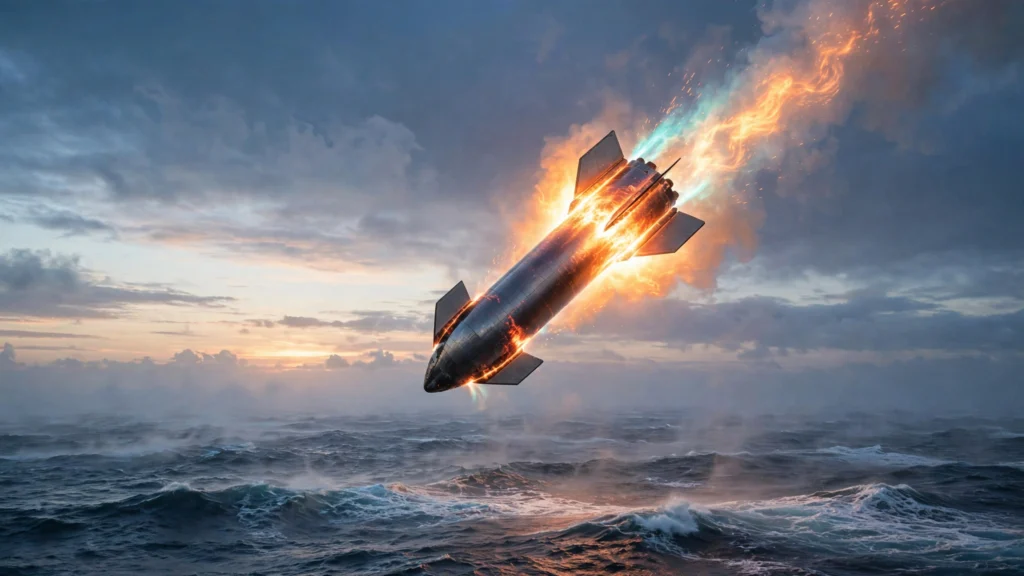
SpaceX had no plans to recover the vehicle, and the landing ended as expected for an expendable test article: the 171-foot upper stage, designated Ship 41, tipped onto its side and was engulfed in a massive fireball. “Splashdown confirmed. Congratulations to the entire SpaceX team on the first orbital flight of Starship!” the video caption read.
NASA Administrator Jared Isaacman congratulated SpaceX on the achievement, writing on X: “Gorgeous launch, getting Ship to orbit and managing every step in a safe, responsible, and especially inspirational way.” NASA is working with SpaceX on missions to return astronauts to the Moon in the coming years.
What comes next for Starship
Flight 14 answered the biggest open question about Starship: can it reach orbit? With that milestone cleared, SpaceX’s test program moves toward the harder problems — routine orbital operations, in-space refueling, and eventually catching and reusing the upper stage the way it already does with the Super Heavy booster.
The stakes are enormous. Starship is the vehicle NASA has chosen to land astronauts on the Moon, and Musk has staked the company’s future — and his Mars ambitions — on making it fully and rapidly reusable. Each flight so far has bought down risk; Flight 14 bought down the biggest risk of all.
If the flight rate holds, the next test could attempt the full-duration mission that Flight 14 had to cut short — six orbits and a precision splashdown — bringing the most powerful rocket ever flown one step closer to operational service.
Pingback: Trump Names Jay Clayton AI Czar to Lead Task Force - RadioSea
Pingback: Starlink India Pricing: Musk Takes on Ambani's Jio