
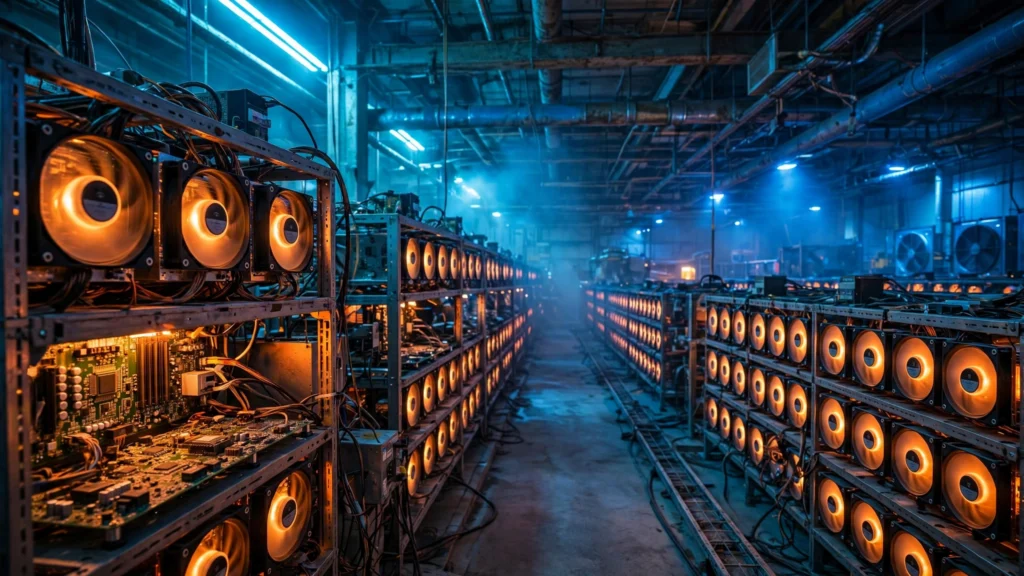
Bitcoin Mining Earnings in 2026: How Miners Get Paid
Bitcoin’s network is stronger than ever. According to CryptoQuant data reported on October 22, the Bitcoin hashrate has climbed roughly 45% from July lows to approximately 1,050 exahashes per second (EH/s) — a record. Public miners are expanding their fleets even as Bitcoin trades around $81,600. So the obvious question for newcomers: how do bitcoin mining earnings actually work, and can ordinary people still profit from mining in 2026?
This guide breaks down where mining income comes from, what it costs, which setups make sense today, and what realistic expectations look like. Figures below reflect current market conditions; mining is volatile and no return is guaranteed.
Where Bitcoin Mining Earnings Come From
Miners are paid in two ways for every block they successfully mine:
- Block subsidy: The network currently pays 3.125 BTC per block to the winning miner, a figure that halves roughly every four years (the next halving is expected around 2028). At current prices near $81,600, each block’s subsidy is worth over $250,000 — but it is split among the entire global network competing for it.
- Transaction fees: Miners also collect the fees attached to the transactions inside each block. Fee income varies with network congestion and has historically been a small fraction of total rewards.
Most miners join a mining pool, combining their hashrate with thousands of others and splitting rewards proportionally. Pools turn lottery-like solo mining into a steady, predictable income stream — with the pool operator taking a fee of roughly 1% to 3%.
Why Mining Earnings Are Harder in 2026
The record 1,050 EH/s hashrate is a double-edged sword. More hashrate means a more secure network, but it also pushes mining difficulty higher — every miner now competes against more total computing power for the same fixed block reward. Analysts note that several publicly traded mining stocks dropped about 12% recently amid inflation headwinds, even as hashrate expanded, showing how thin margins can get.
Three forces shape today’s mining economics:
- Difficulty keeps rising. As industrial miners like NIP Group add capacity, difficulty adjusts upward and each terahash earns slightly less per day.
- Electricity is the main cost. Profitable operations typically need industrial-scale power at a few cents per kilowatt-hour. Residential rates of 10 to 15 cents per kWh rarely work for standalone rigs anymore.
- Hardware depreciates fast. Each new ASIC generation makes older machines less competitive, so miners must reinvest regularly to stay near the efficiency frontier.
Four Ways to Mine in 2026
1. Industrial ASIC hosting
Buying a modern ASIC miner (which can cost several thousand dollars) and placing it in a professional hosting facility is the most common path to serious mining. Hosts charge for electricity and maintenance, and payouts flow daily or weekly to your wallet. This is how most mid-size miners operate today — own the hardware, outsource the logistics.
2. Home mining
Running a single miner at home is possible but rarely profitable in 2026 unless you have unusually cheap power — such as surplus solar or stranded energy. Noise, heat, and power draw (a single modern ASIC can use over 3,000 watts) are practical obstacles. Treat home mining as a hobby or learning project, not an income plan.
3. Cloud mining contracts
Cloud contracts let you rent hashrate without owning hardware. This is the easiest entry point — and the segment with the most scams. Many contracts pay less than their upfront cost over the full term, and fraudulent schemes are common. If you go this route, research the operator’s history, use short terms, and never commit money you cannot afford to lose.
4. Mining stocks and proxy exposure
For investors who want mining-linked returns without hardware, shares of public miners offer exposure to the sector’s profitability. They rise and fall with Bitcoin’s price and each company’s efficiency — analysts track them as a leveraged play on BTC, not as direct mining earnings.
Calculating Realistic Bitcoin Mining Earnings
Before buying anything, run the numbers honestly:
- Estimate daily revenue: Use the machine’s hashrate and the current network difficulty to find its expected BTC output per day, then multiply by Bitcoin’s price. Public calculators make this easy.
- Subtract electricity: Multiply the miner’s wattage by your electricity rate per kWh and 24 hours. This is usually 60% to 90% of total operating cost.
- Include fees and downtime: Pool fees of 1–3%, hosting fees, maintenance, and occasional outages all cut into the result.
- Model the payback: Divide the machine’s all-in cost by estimated daily net profit. Payback periods of 12–24 months are common; longer than that means you are betting on higher Bitcoin prices.
A useful rule of thumb: if the calculation only works at optimistic Bitcoin prices and cheap electricity you cannot lock in, it is a speculation on price, not a mining business.
Risks Nobody Should Skip
Price risk. Mining revenue is denominated in Bitcoin, so a 30% price drop can flip a profitable rig to a loss-making one overnight.
Difficulty and halving risk. Rising difficulty steadily erodes per-machine earnings, and the next halving will cut the block subsidy again. Long payback calculations should assume earnings decay over time.
Operational risk. Hardware fails, hosting facilities raise rates, and mining farms can face regulatory or grid issues. Diversifying across machines and locations reduces single-point failures.
Bitcoin mining in 2026 is an industrial-scale business operating at a record 1,050 EH/s — profitable for those with cheap power, efficient hardware, and realistic math. For everyone else, the honest path is to run the numbers first and only then decide. This article is for informational purposes only and is not financial advice. Do your own research before investing.