
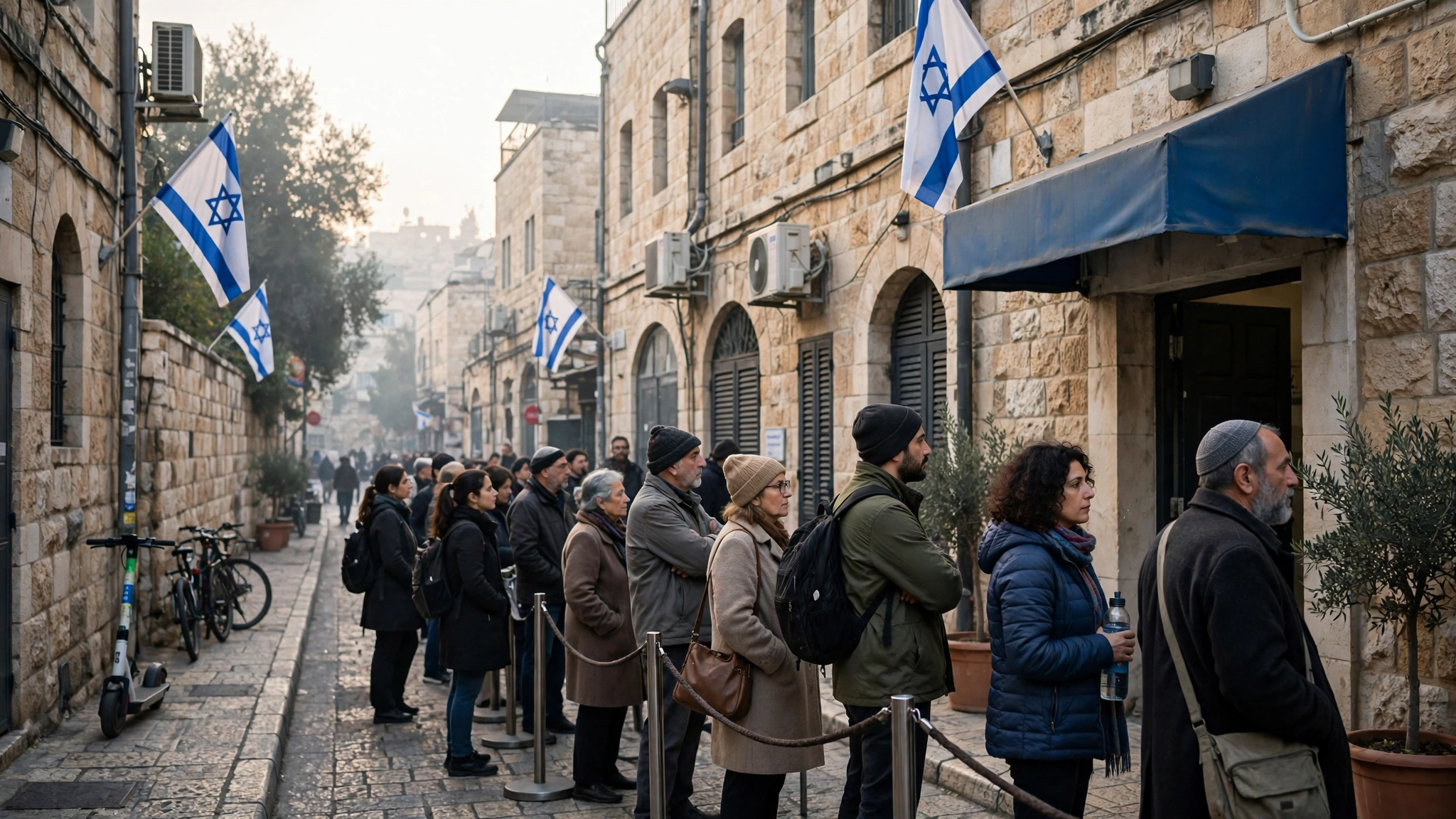
Israel election 2026 voting got underway on Tuesday, October 27, as millions of voters headed to polling stations across the country to elect the 26th Knesset. It is the first national election since the October 7, 2023 Hamas-led attacks and the wars that followed, and it is widely seen as a referendum on the leadership of Prime Minister Benjamin Netanyahu.
Netanyahu voted in Jerusalem alongside his wife Sara, in his first public appearance of election day, according to reports from the scene. President Isaac Herzog also voted in Jerusalem, urging citizens to take part. “We are all equal; this is our day,” Herzog said, in remarks reported by Israeli media.
Polling stations opened across Israel for about 7.3 million eligible voters. The Central Election Commission said voting was taking place at 12,018 regular polling booths and around 300 special locations, including hospitals, prisons and military bases. Officials said about 450 million ballot papers had been printed, and the election budget was about 700 million shekels, or roughly $150 million.
Israel election 2026: a vote shaped by war and its aftermath
The campaign has been dominated by security, the future of Gaza, the cost of the wars, and questions about accountability for the failures that preceded the October 7 attacks. Netanyahu has pointed to military operations carried out since the attacks, while his critics have argued that the country needs new leadership to secure a lasting peace and rebuild trust in government.
Voters interviewed by news agencies on election day spoke about peace, democracy and a better future. One voter described the ballot as the most important in the history of the State of Israel, a sentiment echoed in reporting from Jerusalem and Tel Aviv throughout the morning.
Thousands of police officers were deployed nationwide to secure polling places, according to Israel’s police chief, who also cast a ballot. Election officials said early turnout was strong, with reports of a surge in morning voting compared with previous elections, though final turnout figures will not be known until polls close.
What the final polls showed before voting began
Final polls published in the days before the election pointed to a close race, with neither major bloc reaching the 61 seats needed for a majority in the 120-seat Knesset. Polls from Channel 12, Channel 13, Kan 11 and Maariv put the bloc led by former military chief Gadi Eisenkot and his Yashar party ahead, but only in the low-to-mid 50s.
- Channel 12 put Eisenkot’s bloc at 56 seats and Netanyahu’s bloc at 50 seats.
- Channel 13 put Eisenkot’s bloc at 54 seats and Netanyahu’s bloc at 50 seats.
- Kan 11 put Eisenkot’s bloc at 52 seats and Netanyahu’s bloc at 50 seats.
- Maariv’s final poll put the change bloc at 54 seats and Netanyahu’s bloc at 48 seats.
Those figures, if reflected in the actual count, would leave both camps short of a governing majority and facing weeks of coalition negotiations. Smaller parties, including Arab parties and parties that have not committed to either bloc, could therefore play a decisive role in deciding who forms the next government.
How Israel’s election system works
Israelis vote for parties, not individual candidates, in a proportional system. Parties must pass an electoral threshold to enter the Knesset, and seats are allocated in proportion to each party’s share of the vote. After the results are known, the president consults party leaders and asks the candidate with the best chance of building a coalition to try to form a government.
That process can take weeks, and in recent Israeli political history it has sometimes failed, leading to repeat elections. Analysts say the closeness of this race makes extended negotiations likely, whichever bloc finishes first.
Why the result matters beyond Israel
The outcome is being watched closely in Washington, across the Middle East and in European capitals, because the next Israeli government will shape ceasefire efforts in Gaza, relations with neighbouring states, and security policy in the West Bank. The United States remains Israel’s closest ally, and American officials have a direct interest in whether the next coalition favours a negotiated settlement or a harder security line.
Regional powers are also watching for signals on Gaza’s reconstruction, the return of displaced people, and the future of agreements with Arab states. A government led by Netanyahu’s bloc would be expected to stress security and deterrence, while a government led by his rivals would face pressure from voters who want a clearer path to ending the conflict.
What happens after the polls close
Once voting ends, exit polls will give the first indication of the result, followed by the official count. If no bloc wins a majority, party leaders will begin coalition talks, and the president will play a central role in choosing who gets the first chance to form a government.
For voters, the wait may be long. Coalition agreements in Israel often require compromises on security, religion, the economy and the judiciary, and the parties that hold the balance of power can extract significant concessions. What is clear on election day is that Israelis turned out in large numbers for a vote many see as defining the country’s direction for years to come.
As results come in, attention will turn from the polling stations to the negotiating rooms — and to whether this election produces a stable government, or another period of political uncertainty.