
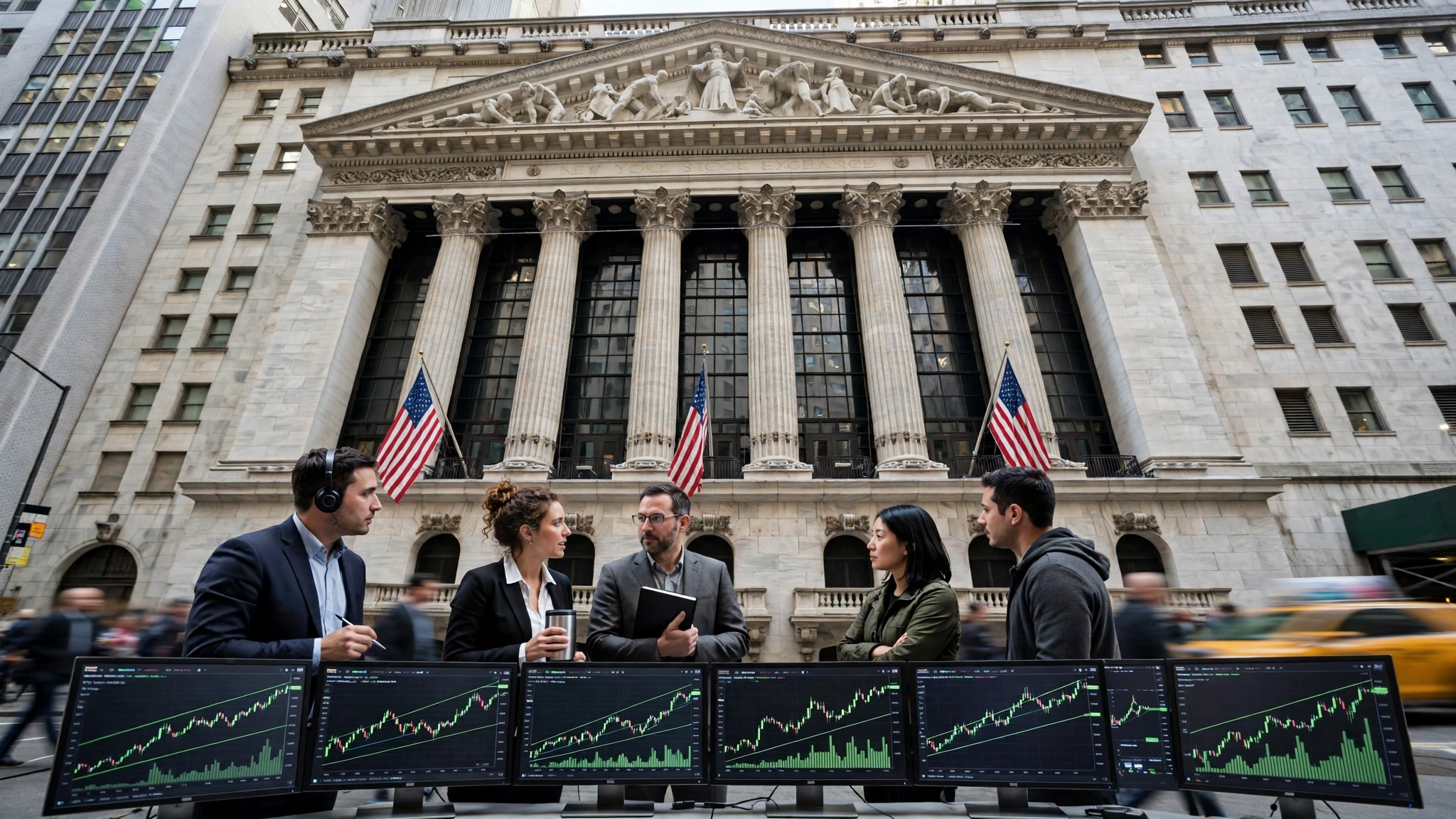
US stock futures rebounded sharply on Wednesday, November 4, reversing early losses as investors assessed the Democrats’ sweeping midterm victories and what divided government could mean for artificial intelligence spending, regulation and taxes. The stock futures midterm sweep reaction swung from fear to relief in a matter of hours, after President Donald Trump accepted the election results.
Reuters reported that US stock index futures rose on Wednesday after initially falling hard in overnight trading. Nasdaq-100 futures had fallen as much as 2.4 percent and S&P 500 futures were down 1.4 percent when the scale of the Democratic win first became clear. By 4:22 a.m. Eastern time, Dow E-minis were up 436 points, or 0.84 percent, S&P 500 E-minis were up 26.75 points, or 0.35 percent, and Nasdaq-100 E-minis were up 44.75 points, or 0.16 percent, according to Reuters.
Later updates showed an even stronger recovery. Morningstar reported that Nasdaq futures jumped 1.1 percent, S&P 500 futures flipped to add 1.1 percent, and Dow futures surged 1.5 percent, retracing the earlier losses. Investopedia reported Dow futures up 1.8 percent, S&P 500 futures up about 0.9 percent and Nasdaq-100 futures up about 0.2 percent on Wednesday morning, with the 10-year Treasury yield at 4.92 percent, down from about 4.97 percent on Tuesday night.
Stock futures midterm sweep: why futures fell, then recovered
The initial sell-off reflected a familiar market fear: a Democratic Congress could bring tougher regulation, higher taxes and closer oversight of fast-growing industries, especially artificial intelligence and cryptocurrencies. Global stocks swung between gains and losses as investors weighed those prospects, and Asian technology shares fell while Treasury yields dipped and the dollar weakened, according to Reuters market analysis.
The rebound came as investors reconsidered that fear. Analysts quoted by Reuters said the market appeared to be recognising that political gridlock does not necessarily mean weaker corporate earnings, and that lower Treasury yields could support share valuations. One strategist described the early move as a knee-jerk response to a surprise result, with the recovery reflecting the view that a balance of power between Congress and the president would keep both parties in check.
Trump’s acceptance of the results also helped. Reuters noted that futures clawed back their losses after the president accepted the outcome and acknowledged that the war in Iran had played a role in Republican losses. That eased concerns about a prolonged political confrontation, even though his veto power means significant policy disagreements remain likely.
- Dow futures rose about 0.84 percent in early trading, later reaching gains of 1.5 percent or more.
- S&P 500 futures recovered from a 1.4 percent fall to trade higher on Wednesday morning.
- Nasdaq-100 futures fell as much as 2.4 percent overnight before rebounding into positive territory.
- Brent crude fell about 1.4 to 1.9 percent, to around $101 to $102 a barrel.
- The 10-year Treasury yield slipped to about 4.92 to 4.93 percent.
AI stocks in focus after the Democratic sweep
The artificial intelligence trade was at the centre of the market debate. Democrats made gains in key data-centre states, where public opposition to the industry’s rapid expansion has been growing, and analysts said a Democratic sweep could slow the expansion of AI infrastructure or increase scrutiny of Big Tech spending.
That trade was already under pressure before the election. The Goldman Sachs broad AI basket was down 15 percent in October and more than 24 percent from its peak, according to a Natixis economist quoted by Reuters, as investors grew wary of soaring AI spending with little evidence of adequate returns. Data-centre stocks including IREN, Hut 8 and Applied Digital declined on Wednesday amid concerns about tighter oversight, according to the Economic Times live blog.
Chip stocks offered a counterweight. Advanced Micro Devices jumped 6.2 percent after forecasting stronger growth in 2027, supported by rising data-centre sales and its growing challenge to Nvidia, the Economic Times reported. AMD reported $13.3 billion in revenue for the quarter, beating expectations, and nearly $2.43 billion in profit, roughly in line with analyst estimates, according to Investopedia. Super Micro Computer also moved after reporting late on Tuesday.
Winners and losers in the post-election trade
Not every sector shared in the recovery. Defence company stocks fell as investors considered what a Democratic Congress could mean for the country’s approach to conflict and international relations. Shares of Northrop Grumman and Lockheed Martin were recently down at least 3 percent on Wednesday morning, Investopedia reported.
Shares of companies controlled by Elon Musk also fell. Morningstar reported that SpaceX and Tesla both fell by around 4 percent in premarket trading, with Tesla indicating that a much-expected merger with SpaceX could face more scrutiny under a Democratic Congress. Oil contracts fell as well, with Brent crude for January delivery dropping 1.4 percent to about $102.20 a barrel, according to Morningstar.
JPMorgan had warned before the election that a Democratic sweep could bring higher policy and regulatory uncertainty, including implications for AI, and that this might weigh on sentiment even if no major legislation followed immediately. That warning helps explain why the market’s first reaction was negative — and why the recovery, while real, may not settle the debate.
What investors watch next
Investors will now watch the final results trickle in and listen closely to Democratic leaders for clues about their policy priorities, Morningstar reported. Earnings also remain in focus: McDonald’s was due to report on Wednesday morning, with analysts expecting about $7.3 billion in revenue and $2.4 billion in net profit, according to Visible Alpha figures cited by Investopedia.
History offers some comfort to buyers: analysis cited by NDTV Profit noted that the S&P 500 has risen in the year after every midterm election since 1949, averaging 20.3 percent. That pattern is not a guarantee, and this year’s backdrop is unusually complex.
For now, the market’s message on Wednesday was measured: the election changed Washington, but it did not change corporate earnings overnight. Whether that calm holds will depend on what the new Congress actually does when it takes office in January.
1 thought on “Stock Futures Rebound After Democrats Sweep 2026 Midterms”