
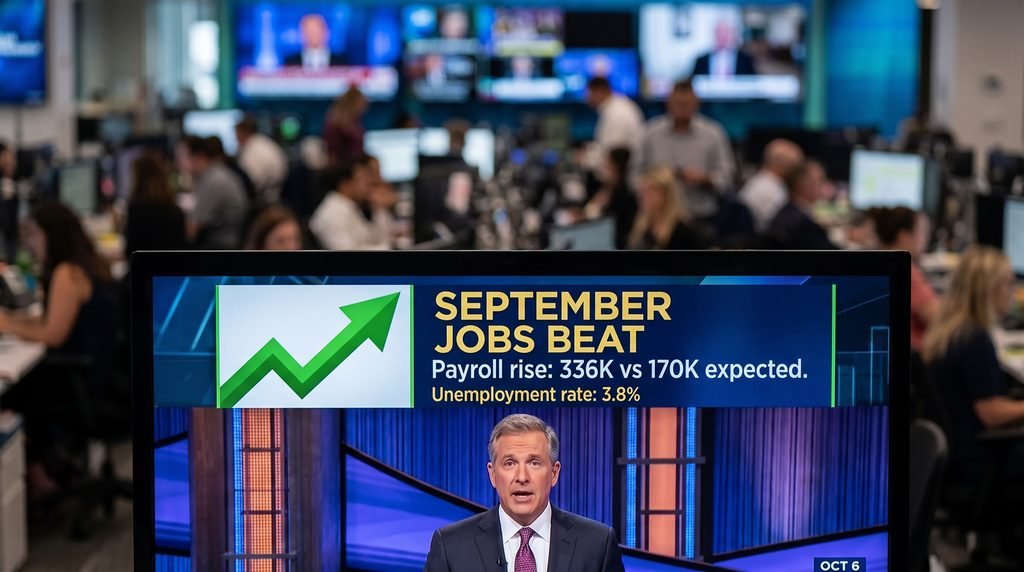
September Jobs Beat: 90K Added — What It Means for Rates
The September jobs report came in hotter than expected. U.S. private employers added 90,000 jobs in September, according to ADP, easily beating the 70,000 forecast and more than doubling August’s revised gain of 36,000.
The upside surprise signals the labor market still has some fight left — and it arrives on a morning packed with data that will shape the Federal Reserve’s next move on interest rates. The Fed’s preferred inflation gauge, the PCE price index, drops later this morning.
September Jobs Report: The Key Numbers
Here is what the ADP report showed:
- September private payrolls: +90,000 jobs
- Economist forecast: +70,000 jobs
- August (revised): +36,000 jobs
- Trend: Hiring accelerated after a weak summer
The 90,000 gain is a meaningful rebound from August’s sluggish pace. While far below the blockbuster job growth of the early 2020s, it is strong enough to ease fears that the labor market was rolling over.
Why the September Jobs Report Matters for the Fed
The Federal Reserve has a dual mandate: keep prices stable and maximize employment. A stronger-than-expected September jobs report cuts both ways.
On one hand, healthy hiring means the economy is not falling into a downturn. On the other, a resilient labor market can keep wage growth elevated, which risks keeping inflation sticky — making it harder for the Fed to justify aggressive rate cuts.
Markets have been betting on a series of rate cuts. A hot jobs number forces investors to rethink how fast — and how far — the Fed will move.
What Is the PCE Inflation Gauge?
The PCE (Personal Consumption Expenditures) price index is the Fed’s preferred measure of inflation. It tracks what Americans actually spend on goods and services, and it updates the basket of items more frequently than the consumer price index.
Fed officials pay closest attention to core PCE, which strips out volatile food and energy prices. Today’s PCE reading, combined with the strong September jobs report, will frame the debate at the Fed’s next policy meeting.
Market Reaction: Bonds, Stocks, and the 10-Year
The bond market moved quickly on the news. The 10-year Treasury yield sits at 5.24%, reflecting expectations that rates may stay higher for longer.
Higher yields mean higher borrowing costs across the economy — from mortgages to business loans. For stocks, the picture is mixed: strong hiring supports corporate earnings, but slower rate cuts remove a tailwind that fueled the market’s rally.
The Dow Jones Industrial Average is on pace to snap a five-month winning streak, a sign that investors are recalibrating.
What the September Jobs Report Means for You
- Mortgage rates: A strong jobs number keeps upward pressure on the 10-year yield, which mortgage rates track. Borrowers hoping for big drops may need to wait.
- Credit cards and auto loans: Fed rate cuts flow through to variable-rate debt slowly. Fewer cuts mean less relief on monthly payments.
- Job seekers: The 90K gain suggests employers are still hiring, though selectively. The labor market is cooling — not collapsing.
- Savers: Higher-for-longer rates keep savings account and CD yields elevated, a silver lining for cash holders.
- Wages: Continued hiring supports wage growth, but pay gains have been normalizing from their post-pandemic peaks.
What Comes Next: Fed Decision Watch
All eyes now turn to the Fed. Officials have signaled they want to see inflation sustainably back toward their 2% target before easing policy in a meaningful way. The September jobs report gives the hawks ammunition to argue for patience.
The key question: was September a one-month bounce, or the start of a reacceleration? For now, the message from the data is clear — the U.S. economy is bending, not breaking. And for interest rates, that likely means the Fed stays careful, not quick.
FAQ: September Jobs Report
How many jobs were added in September?
U.S. private employers added 90,000 jobs in September, according to ADP — above the 70,000 forecast and up sharply from August’s revised 36,000.
What is the September jobs report?
It is the monthly snapshot of U.S. labor market data, including the ADP private payrolls report and the government’s official employment report.
What does the strong jobs report mean for Fed rate cuts?
A stronger-than-expected report reduces pressure on the Fed to cut rates quickly. Officials may keep rates higher for longer to ensure inflation stays under control.
What is PCE inflation?
PCE — the Personal Consumption Expenditures price index — is the Federal Reserve’s preferred inflation gauge, measuring what Americans spend on goods and services. Core PCE excludes food and energy.
Why is the 10-year Treasury yield rising?
Strong economic data, including the September jobs beat, pushes yields higher as investors expect the Fed to cut rates more slowly.
Pingback: Mesabi Metallics Iowa Steel Plant: Trump Unveils $15B Mill - RadioSea
Pingback: US Jobs Report: Just 29,000 Jobs Added, Unemployment 4.2% - RadioSea
Pingback: Trump Cost-of-Living Approval Sinks to Record Low 17% - RadioSea
Pingback: Canada Import Ban Explained: $1B US Ban and What It Means – RadioSea
Pingback: Amazon Hiring 300,000 Workers for 2026 Holiday Season Rush