
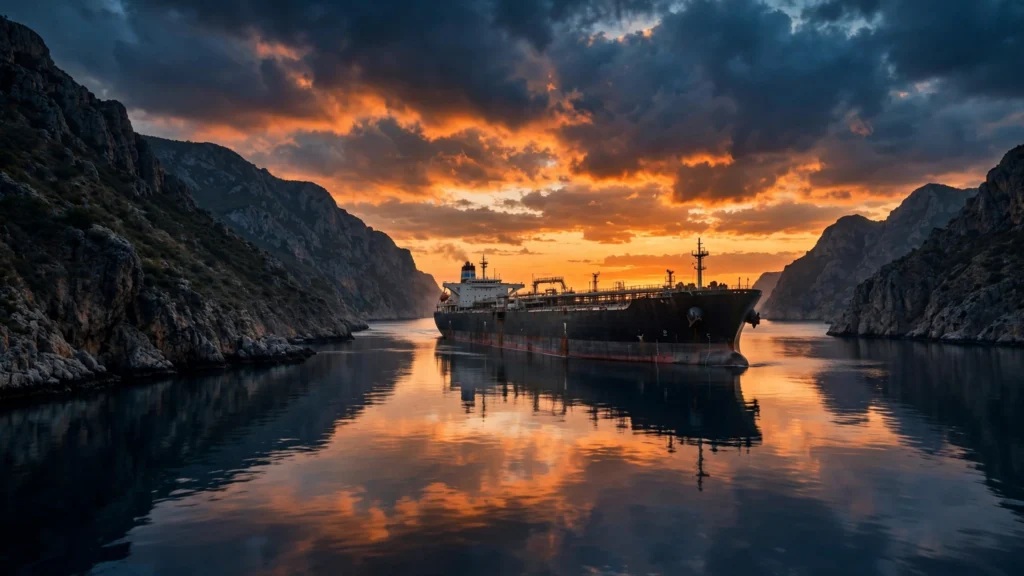
Strait of Hormuz: Trump Rejects Iran’s Seven-Day Deal
President Donald Trump on Saturday rejected Iran’s proposal to reopen the Strait of Hormuz within seven days and resume negotiations over its nuclear program, deepening a standoff that has kept one of the world’s most important oil shipping routes effectively closed for months. The decision, announced as Trump spoke to reporters outside the White House, sent crude oil prices sharply higher and fueled warnings from analysts that the United States could resume bombing Iran after November’s midterm elections.
“I reject their proposal,” Trump told reporters before departing for Tennessee, according to the Associated Press. The president said Iranian officials are pushing for a deal because they are “losing so badly” in the conflict that began when the United States and Israel attacked Iran in late February.
The Strait of Hormuz carries a large share of the world’s seaborne oil exports, and its effective closure has strained global energy markets for months. With the proposal now dead, the waterway remains a dangerous pressure point in a war that has already pushed oil prices to their highest levels this year.
What Iran Offered at the United Nations
Iranian Foreign Minister Abbas Araghchi unveiled the proposal Thursday on the sidelines of the United Nations General Assembly in New York. Under the plan, Tehran would reopen the strait on the seventh day and return to the negotiating table if the United States met a set of conditions.
According to Iranian officials and media reports, those conditions included:
- An end to what Tehran described as U.S. “acts of aggression”
- Lifting the American naval blockade of Iranian ports
- Waivers on sanctions against Iranian oil sales
- The release of an estimated $12 billion in frozen Iranian assets
- A ceasefire across the region that would include Lebanon
“If certain conditions are met, the Strait of Hormuz will be open at the end of seven days, and talks will be restarted,” Araghchi told reporters in New York, as reported by CNBC Africa.
The offer emerged from indirect talks on the UNGA sidelines between U.S. envoys Steve Witkoff and Jared Kushner and Araghchi, with Qatari officials shuttling messages between the two delegations, according to Axios. Araghchi later said Tehran was waiting for a clear American response to the plan.
The proposal closely resembled a peace framework reached in June, but with a much faster timetable. That earlier agreement, which envisioned a 60-day interim period, collapsed after Iran resumed attacks on shipping in the strait, according to the Indian Express.
Why Trump Said No
Trump told reporters that Iran wanted to open the strait immediately because it is losing the war, and he described the terms on the table as unacceptable. “They want to make a deal and I think that’s fine,” he said. “I’d like to make a deal, too. But that deal would not be acceptable.”
The president has insisted throughout the standoff that Iran cannot be allowed to obtain a nuclear weapon, repeating the message in all caps on his Truth Social account. He also shared a map of the waterway with the route circled and labeled the “Trump Strait,” underscoring his claim that the United States exercises control over the shipping lane.
According to the Wall Street Journal, Trump told aides he rejected the offer in part because he doubts Tehran would honor its commitments. The Journal also reported, citing unnamed U.S. officials, that the president expects American strikes on Iran to resume after the midterm elections.
Speaking to Axios on Sunday, Trump struck a somewhat different note, saying he expects U.S. negotiators to hold more talks with Iran this week, with Qatari mediators still working to keep the indirect channel alive. “They overplayed their hand,” he said of Tehran’s offer.
Oil Prices Jump as the Strait of Hormuz Stays Blocked
Energy markets reacted swiftly to the rejection. In Monday trading in Asia, U.S. crude futures for November delivery rose 1.87% to $94.14 a barrel, while international benchmark Brent crude gained 2.89% to $107.34, according to CNBC Africa.
Iran effectively closed the strait after the U.S. and Israeli attacks in late February, and the number of ships passing through has dropped significantly because of Iranian threats and attacks on vessels in the waterway, the Associated Press reported. The disruption has already contributed to higher fuel costs for American consumers.
The war that Trump launched alongside Israel in February has spiked oil prices and weighed on his approval ratings, the Indian Express noted. With the midterm elections approaching, the state of the economy and energy prices have become central political issues for the White House.
Analysts Warn of Escalation After the Midterms
Regional analysts say the collapse of the seven-day proposal leaves few diplomatic off-ramps. Both sides negotiated indirectly while trading threats — Trump threatened to “annihilate” Iran during the UNGA session, while Iranian President Masoud Pezeshkian vowed to fight “until our last breath,” according to the Indian Express.
Pezeshkian ended his U.N. speech by saying Tehran remains open to diplomacy, but Iranian officials have made clear they will not negotiate under military pressure. Iran’s Mehr news agency reported Saturday that Tehran warned of risks to American interests if Washington “makes a mistake.”
Separately, the Saudi-led coalition in Yemen said Saturday it had intercepted projectiles launched by Iran-backed Houthi rebels — a reminder that the conflict extends well beyond the strait itself.
For now, attention turns to whether the Qatari-mediated channel produces a new round of talks this week, and to what the White House decides once the midterm votes are counted.