
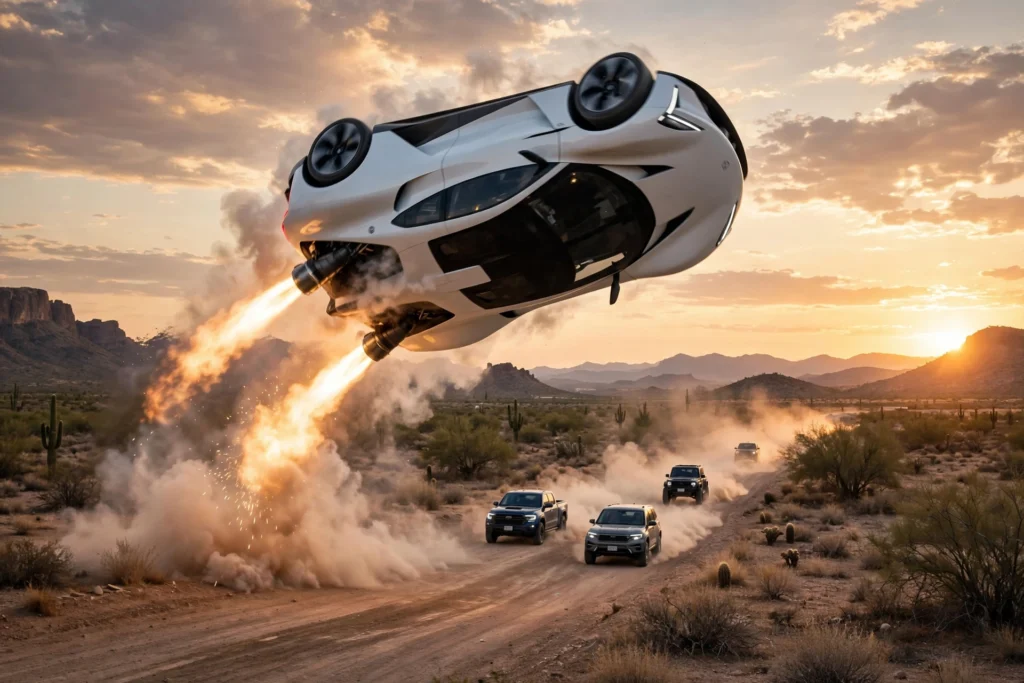
Tesla’s Flying Roadster With SpaceX Thrusters Unveiled
Elon Musk pulled back the curtain Thursday on a redesigned Tesla Roadster with SpaceX cold-gas thrusters — a sports car that can drive upside down on a ramp, turn in the air, and leap over vehicles — and said the long-delayed vehicle will finally enter production in 2028.
The unveiling at a SpaceX test site in McGregor, Texas, marks the latest chapter for one of Tesla’s most delayed products. The company first revealed a prototype of the second-generation Roadster in 2017 and said at the time that deliveries would begin in 2020. Tesla shares were up 5% in premarket trading Friday.
Tesla Flying Roadster: What the Thrusters Can Do
The white two-seater, developed in collaboration with Musk’s rocket company SpaceX, demonstrated its capabilities live at the event near Waco, Texas:
- Drove upside down on a ramp using a suction system, then turned in the air and landed with built-in thrusters.
- Jumped over a truck and other vehicles — a Cybercab, Cybertruck, Tesla Semi, Model Y and Model 3 — while twisting in the air.
- Sub-one-second 0–60 mph acceleration, according to Tesla vehicle engineering chief Lars Moravy, with a top speed above 230 mph.
“This is the culmination of incredible work by Tesla and SpaceX engineers working closely together to make something that you haven’t seen in any movie,” Musk said at the event. Before the demonstration, he cautioned attendees that “success is not guaranteed,” adding, “I mean that. It’ll probably work, but if it doesn’t work, we’re at a safe distance.”
Three Trims, One Flying Car
Tesla will offer the Roadster in three trims, all with 300 miles of range and speeds exceeding 230 miles per hour, according to TechCrunch:
- Performance — “road ready,” seats two, with active aerodynamics and a “multi-mode suction system for next-level performance on and off the track.”
- Thrust — “race ready,” seats two, with rear-mounted cold-gas thrusters enabling sub-one-second 0-to-60 acceleration.
- Rocket — “air ready,” seats one, with 10 cold-gas thrusters positioned around the car.
“This will be the actual car that’s on the roads,” Musk said. “It literally is just going to puff itself up, and uh, and be able to do this, these maneuvers whenever you’d like.”
Tesla’s website showed Thursday the company is taking reservations, charging $50,000 to reserve the Performance trim and $250,000 for the Thrust trim. The Rocket trim is billed as “invite only.” No target price for the production car was announced; when the vehicle was first introduced nearly a decade ago, the company quoted a base price of $200,000.
The Merger Question: Tesla Meets SpaceX
Some watchers saw the collaboration as Musk drumming up interest in a merger of the two big companies he controls, an idea he has explored by discussing their overlap. “The Roadster event is the latest example of why Elon can’t wait to bring (Tesla) and (SpaceX) together,” Gene Munster, managing partner at Tesla investor Deepwater Asset Management, said on X, calling the reveal “an engineering flex with no commercial value beyond embarrassing traditional car makers.”
Musk has played down the car’s importance to Tesla’s finances, describing it in 2023 as a “small potato situation” that would not “move the needle in a major way financially.” But analysts say it carries symbolic weight: “Tesla does not currently have a halo car, or high-performance luxury vehicle designed to showcase an automaker’s best engineering and technology. The Roadster will be Tesla’s new halo car,” Morningstar analyst Seth Goldstein said in a note last month.
Legal and Practical Questions Remain
The use and legality of features like thrusters and inverted driving on public roads were not immediately clear, USA Today reported. Regulators have not weighed in on how a car designed to leave the ground would be certified for road use.
The reveal also comes as Tesla shifts its focus to self-driving technology and robotics — and days before third-quarter earnings that analysts say matter more to investors than the showpiece car.
Why the Tesla Flying Roadster Matters for EVs
Whether or not the Roadster ever becomes a mass-market reality, the demonstration pushes the boundaries of what electric vehicles can do. Cold-gas thrusters — long used in spacecraft for attitude control — have never been deployed on a production car, and the engineering behind them could eventually filter into performance EVs from other automakers.
For now, the flying Roadster stands as Tesla’s boldest statement in years: a sports car that doesn’t just accelerate past everything else on the road — it can leave the road entirely.
Tesla says production begins in 2028. This article will be updated with pricing and regulatory details as they are announced.