
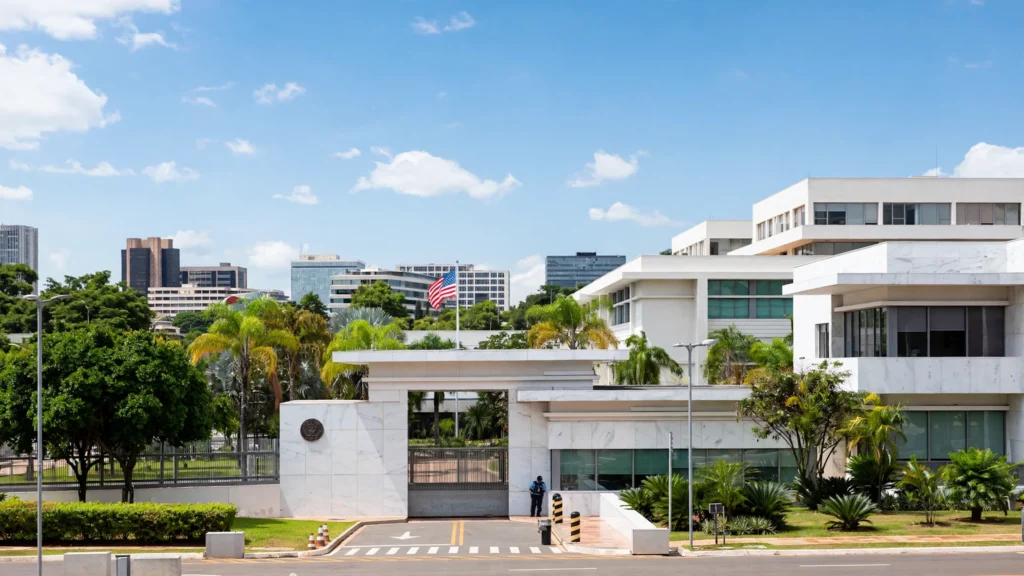
US Halts Consular Services in Brazil Ahead of Election
The United States suspended US consular services Brazil operations on Friday, a move the State Department attributed to unspecified security concerns just two days before Brazil’s presidential election, according to Reuters reporting from Washington and Sao Paulo.
Australia also closed its embassy in Brasilia on Friday, citing the US alert. Brazil’s Federal Police said they carried out preventive searches in Sao Paulo and near Brasilia but had so far found no evidence of a threat and had not identified suspects linked to criminal organizations, Reuters reported.
The State Department did not elaborate on the security issues or link them directly to Sunday’s election. It also did not say when consular services would resume.
What US Consular Services Brazil Suspension Means
In a statement issued Thursday, the US Embassy said consular services at the embassy and consulates in Brazil would be suspended starting Friday, October 2, due to security concerns. US citizens seeking emergency assistance were advised not to come to the embassy, the consulates, or other US diplomatic facilities, and to contact the appropriate duty officer instead.
A State Department spokesperson said in an email that the United States is working closely with Brazilian counterparts to address the security concerns. Brazil’s foreign ministry declined to comment, according to Reuters and the Associated Press.
Routine consular services typically include visa interviews, passport renewals for US citizens abroad, and notarial services. A suspension does not necessarily mean the embassy itself is evacuated, but it does mean in-person routine services are paused and access is restricted.
- Suspension began: Friday, October 2
- Reason given: unspecified security concerns
- Guidance: US citizens should not visit facilities for emergency help; use duty officer contact
- Resumption: no date announced
- Australia: embassy in Brasilia also closed Friday
Election Tensions in the Background
The timing matters. Brazilians vote for president on Sunday in a race that will determine whether Latin America’s largest nation follows the conservative shift that President Donald Trump has often cheered from Washington, or charts a different course under President Luiz Inacio Lula da Silva’s government.
Lula has warned of foreign interference in the election, including fresh tariffs from Washington, Reuters reported. Violent crime has also dominated voter concerns in election polls, prompting candidates to pledge tougher security measures.
The State Department made its announcement at a tense moment for US-Brazil relations. Even without a stated link to the election, a security-driven closure two days before voting inevitably raises questions about the threat picture and about whether foreign missions expect unrest around the vote.
Brazil’s Federal Police described their operation as preventive and said it resulted from ongoing cooperation with foreign intelligence agencies. Investigators seized communication equipment but found no evidence to corroborate the initial reported risks, the Associated Press reported. The investigation remains ongoing.
Why Australia Followed the US Lead
Australia’s ambassador to Brazil, Sophie Davies, said on social media that the Australian embassy in Brasilia would also be closed on Friday due to security concerns, citing the alert issued by the US. She advised Australians to avoid US embassies and consulates in Brazil and surrounding areas.
It is common for allied missions to align closures when a threat is believed to target diplomatic facilities generally, or when a host country advises heightened caution. Australia’s decision does not independently confirm the nature of the threat, but it signals that at least one other government judged the US warning credible enough to act on.
What Travelers and Expats Should Do Now
For US citizens in Brazil, the practical guidance is narrow but important. Do not go to the embassy or a consulate expecting routine services or walk-in emergency help. Use the State Department’s emergency contact channels and follow local police guidance.
For people with upcoming visa interviews or passport appointments, expect rescheduling. The State Department has not announced how appointments will be rebooked. Applicants should monitor the embassy’s website and their appointment confirmation email for updates rather than traveling to a facility.
- Check the US Embassy Brazil website for service resumption notices
- Keep passport and local ID accessible; avoid large gatherings near diplomatic sites
- Monitor local news for Federal Police updates
- US citizens abroad can enroll in the Smart Traveler Enrollment Program for alerts
Brazilian citizens planning travel to the United States may face delays if visa processing is paused for more than a few days. The length of the disruption will depend on when the security assessment clears.
What to Watch Before Sunday’s Vote
Three questions will shape the next 48 hours. First, will Brazilian authorities identify a specific threat or publicly clear diplomatic sites? The Federal Police statement that no evidence has been found so far suggests the concern may have been precautionary, but the ongoing investigation means officials are not ready to declare it resolved.
Second, will other foreign missions follow the US and Australia? Additional closures would raise the perceived risk level; a quiet weekend with no further closures would suggest the threat was limited or has passed.
Third, when will consular services resume? A Monday reopening would frame the suspension as a short, election-weekend precaution. A longer closure would imply a more serious or unresolved threat and could become a diplomatic story in its own right, especially if it affects visa issuance during a busy travel period.
For now, the facts are limited by design. Security-related closures are rarely explained in detail while an investigation is active. What is clear is that two governments chose to close doors rather than risk staff and visitors, and that Brazilian police have not publicly substantiated the feared threat. Voters will cast ballots Sunday with that uncertainty still in the background.