
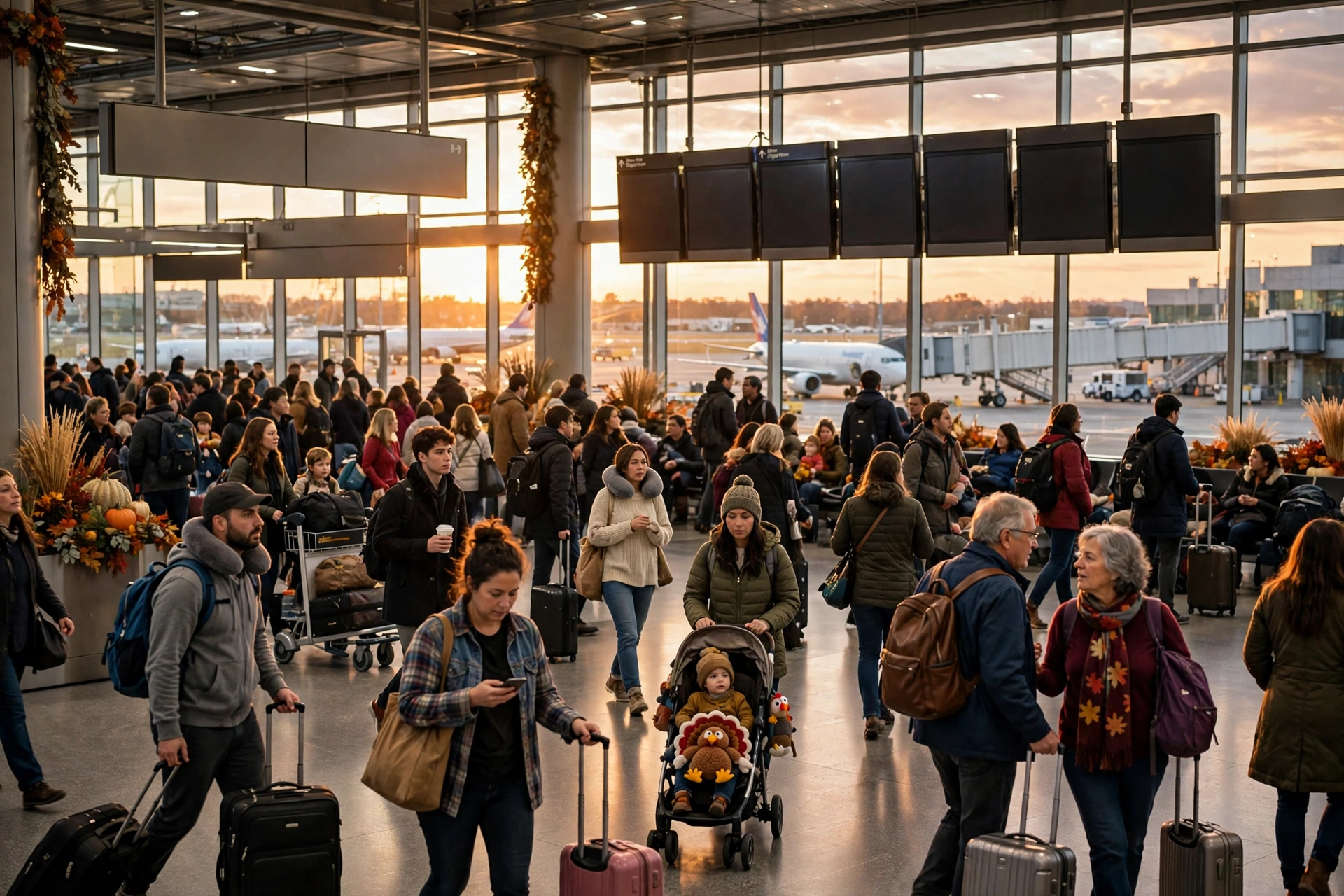
Thanksgiving week is about to test America’s airports, highways, and patience — and this year the trip will cost more than it has in a decade. AAA projects 81.5 million Americans will travel at least 50 miles from home between Tuesday, November 24, and Monday, November 30.
That is a hair below last year’s 81.6 million, ending a three-year run of record Thanksgivings — not because people stopped traveling, but because getting there got expensive. Domestic round-trip flights are averaging $800, up 17 percent from last year, and drivers face record pump prices.
“After three years of record highs, the number of travelers is slightly lower partly because of higher travel costs this year,” said Stacey Barber, vice president of AAA Travel. “But travelers won’t notice much of a difference on the roads and at the airports, since projected volumes remain near record levels.”
Thanksgiving Travel 2026 by the Numbers
AAA published its forecast on November 16, and the breakdown shows a holiday reshaped by cost:
- By car: 72.9 million people will drive, about 200,000 fewer than in 2025, accounting for nearly 90 percent of all Thanksgiving travel.
- By air: 5.96 million travelers will take domestic flights, down 0.2 percent from last year.
- By bus, train, and cruise: 2.6 million travelers, up 4.1 percent — the only growing category.
- Average domestic round-trip fare: $800, up 17 percent.
- Regular gasoline: $3.81 per gallon nationally as of November 16, with record pump prices cited as one reason for the dip in driving.
The 81.5 million total still exceeds pre-pandemic Thanksgiving travel by 3.7 million people, according to AAA. The streak that ended was one of volume, not enthusiasm: Americans are still traveling in near-record numbers; they are simply paying much more to do it.
Why Flights Cost 17 Percent More
Airlines point to fuel. Airlines for America, the industry trade body, says the jet fuel spot price averaged a record $4.64 a gallon in October, and that jet fuel “has risen more than 6x the price of airfares since January.” The U.S. Energy Information Administration’s Gulf Coast benchmark averaged $4.483 per gallon in October — more than double the $2.154 of a year earlier, a jump of 108 percent.
The fuel bill is reshaping how airlines operate. Airlines for America says carriers are cutting frequencies and less profitable routes, retiring older aircraft, and raising checked-bag fees.
AAA’s 17 percent fare figure is based on what travelers actually paid when they booked, not on a market-wide fare index — which makes it a useful measure of what the holiday is really costing families.
Airlines Add Seats for the Rush
Despite the higher fares, airlines are still staffing up for the rush. American Airlines said on November 9 that it and its regional partners expect more than 8 million customers on nearly 85,000 flights between November 19 and December 1, a schedule 4 percent larger than in 2025. Its biggest day is Sunday, November 29, with 7,021 flights — which American calls its largest operating day since the pandemic.
United Airlines expects more than 500,000 customers a day on more than 4,800 daily flights from November 19 through December 1, and about 600,000 on Sunday, November 29. Amtrak is expecting a record number of passengers and is adding capacity along its Northeast Corridor from November 20 to 30.
Airlines for America expects nearly 29 million passengers from Friday, November 20, through Monday, November 30 — about 2.7 million a day — with 38,000 more seats a day than in 2025. The seats are there. The cheap fares are not.
Will TSA Set a Record on Sunday?
The single biggest question of the week is whether the Transportation Security Administration sets a new all-time screening record. The record stands at 3,134,613 people screened on Sunday, November 30, 2025 — the Sunday after Thanksgiving last year.
TSA said in a November 18 release that early indicators show “the potential to screen more than 3 million passengers nationwide on Sunday, Nov. 29.” It would be a comeback: no day in 2026 has yet reached 3 million, and the year’s peak so far is 2,988,204, on June 18.
Traffic data from INRIX, released alongside the AAA forecast, show the Tuesday and Wednesday before Thanksgiving as the busiest days for getting out of town, and Sunday and Monday as the heaviest days for coming home. The worst drive times are Tuesday from 2 p.m. to 8 p.m. and Wednesday from noon to 7 p.m., while Thanksgiving Day itself should be light.
Tips for the Holiday Rush
Travel experts advise flying early in the day when possible, since morning flights are less likely to be delayed by cascading disruptions. Drivers should leave before the afternoon rush on Tuesday and Wednesday, and travelers flying home Sunday should arrive at the airport earlier than usual, with TSA lines expected to be at their longest.
For families weighing the cost, the numbers are stark: a family of four flying domestically could pay about $3,200 in airfare alone this year, before bags, parking, and ground transport. Driving remains the cheaper option for most, even with record gas prices — one reason nearly nine in ten Thanksgiving travelers are taking the car.
2 thoughts on “Thanksgiving Travel 2026: 81.5 Million Hit Roads and Skies”