
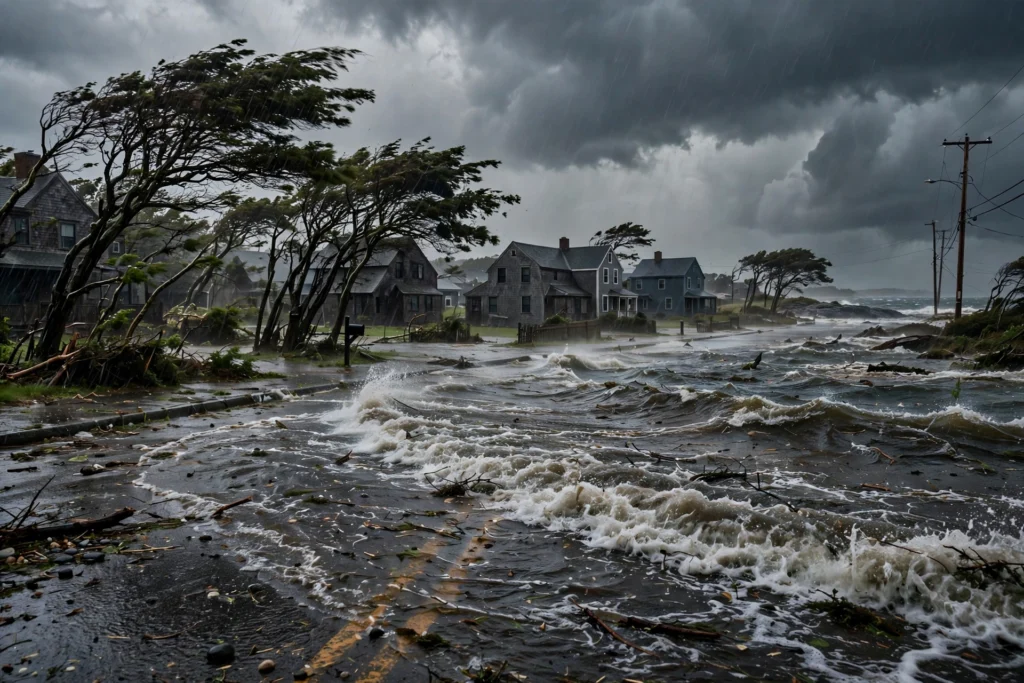
Nor’easter Slams Northeast With Floods and Power Outages
A rare and powerful September nor’easter battered the northeastern United States over the weekend, flooding coastal communities from New Jersey to New England, knocking out power to hundreds of thousands of homes and businesses, and forcing the cancellation of hundreds of flights. The storm, which forecasters compared to Hurricane Sandy, killed one person in New York City when a falling tree struck a housing authority worker in Brooklyn.
The slow-moving system formed on September 23 and dissipated on September 29. At its peak, more than 200,000 customers lost power across the Northeast and mid-Atlantic, while nearly 550 flights were canceled as of September 28, according to storm summaries and flight-tracking data.
Although nor’easters typically strike in late fall and winter, meteorologists described this system as an unusually intense early-season storm, drawing comparisons to Sandy, Hurricane Irene, Hurricane Bob and Hurricane Gloria for the scale of its coastal flooding.
Nor’easter Flooding Stretches From New Jersey to New England
The storm delivered repeated rounds of tidal flooding over the weekend, swamping low-lying neighborhoods from New Jersey to New England. In some parts of New Jersey, more than 4 inches of rain fell on top of a surging ocean, producing flooding not seen in nearly a decade, residents told Al Jazeera.
Floodwaters turned streets into rivers in Ocean City, Maryland, where the Oceans Calling music festival was underway — video showed people navigating the high water by kayak. In New York City, streets in the Howard Beach neighborhood of Queens were inundated.
Officials in Atlantic City said the storm caused the worst beach erosion since Hurricane Sandy in 2012, destroying ramps and uncovering rocks long buried under sand. On Nantucket, the pounding surf unearthed what may be a 19th-century shipwreck; the Maria Mitchell Association is investigating whether the wreckage is the Warren Sawyer, a schooner that ran aground off the island in 1884.
The governors of New York and New Jersey declared states of emergency in the hardest-hit counties. “We’re not out of the woods yet,” New Jersey Gov. Mikie Sherrill posted on X, urging residents to check on neighbors and follow local guidance. New York Gov. Kathy Hochul warned beachgoers bluntly: “Anyone who goes in or near the water this weekend is literally gambling with their life.”
Power Outages and Flight Cancellations Mount
At the height of the storm, well over 100,000 customers were without power at times across the Northeast and mid-Atlantic, according to PowerOutage.us, with the most widespread outages in coastal counties from New Jersey to Connecticut. Utility crews worked through the weekend as falling trees and poles brought down power lines.
Air travel was thrown into chaos. More than 250 flights were canceled at Boston Logan International Airport on Sunday as wind gusts hit 40 mph, according to the Massachusetts Port Authority. FlightAware data showed about 425 cancellations and more than 3,000 delays nationwide as of late Saturday, with disruptions rippling up and down the East Coast.
Winds reaching 70 and 80 mph were recorded in multiple states, and the storm’s lowest pressure dipped to 986 millibars. The strongest gust — 81 mph — was measured at Montauk, New York, according to the storm’s meteorological summary.
One Death, Canceled Events and a Lingering Threat
Authorities tied one death to the storm. Leighton Brown, a 56-year-old New York City Housing Authority employee, died Saturday when a tree fell on him in Brooklyn, city officials said. Four other people suffered minor injuries when a tree fell at a Brooklyn playground.
New York City Mayor Zohran Mamdani urged residents to avoid unnecessary travel and to stay out of floodwater.
The storm forced a wave of high-profile cancellations. Organizers scrapped the Global Citizen Festival in Central Park, which had been set to feature Lauryn Hill, Wyclef Jean and John Legend. Ed Sheeran’s concerts at Gillette Stadium near Boston on Friday and Saturday were called off, and a professional soccer match between Red Bull New York and St. Louis City SC was postponed.
Forecasters said the nor’easter would continue weakening as it moved toward the Gulf of Maine, with rain bands lingering over New England before the system reaches Canada on September 30. Coastal flood advisories remained in effect in parts of the Northeast, with minor flooding possible around high tide.
While this storm’s impact fell far short of Sandy’s $60 billion in damage, Al Jazeera noted it could be the first of several East Coast systems this fall, as an El Niño climate pattern disrupts typical weather. For residents still mopping out basements and waiting for the lights to come back on, the season is off to a punishing start.