
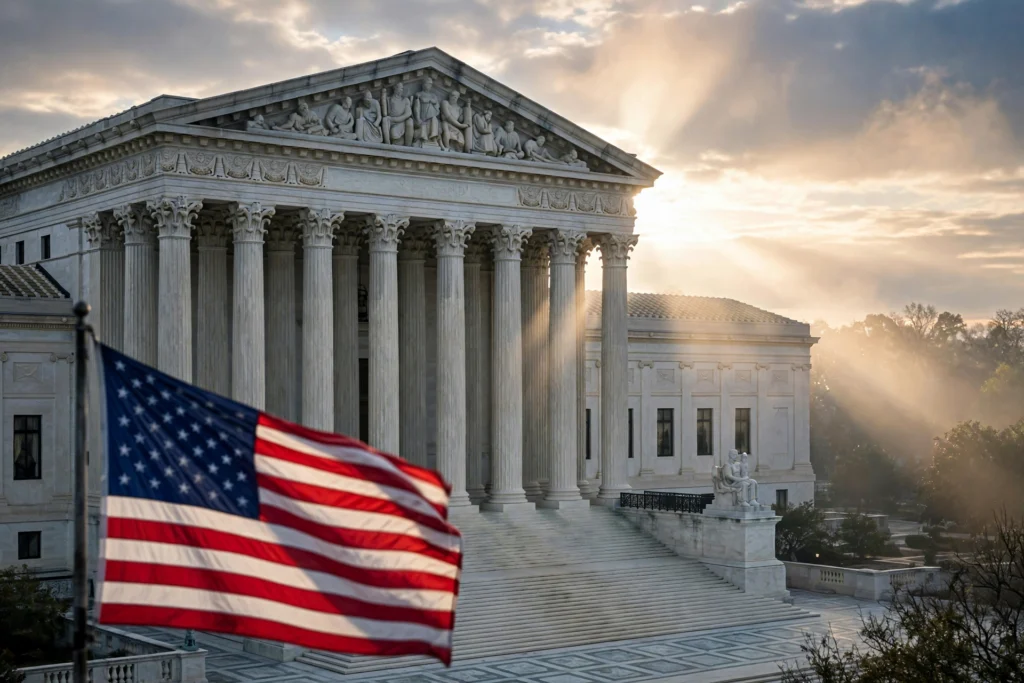
Trump Tariffs: Supreme Court Ruling Triggers Refund Fight
The legal war over Trump tariffs has entered a costly new phase after the U.S. Supreme Court struck down the president’s sweeping emergency duties in a 6-3 decision, forcing the administration to return tens of billions of dollars to importers. The February 20 ruling found that the president exceeded his authority by imposing the tariffs under a 1977 emergency powers law — and it set off a scramble inside the White House to rebuild the trade barriers under different legal authorities.
According to a court filing by U.S. Customs officials in August, the administration had already refunded about $100 billion in duties plus interest — more than half of the $166 billion collected under the invalidated tariffs. The refunds were processed through the government’s entry-refund system and sent to the Treasury Department for disbursement.
How the Supreme Court Ruled on Trump Tariffs
The justices ruled that the International Emergency Economic Powers Act, or IEEPA, does not authorize the president to unilaterally impose tariffs on goods imported from trading partners. The opinion, written by Chief Justice John Roberts, held that the Constitution gives Congress the power over taxes and tariffs, and that Congress had not clearly authorized the president to act alone.
The administration had argued that persistent U.S. trade deficits amounted to a national emergency justifying the duties, which Trump launched on what he called “Liberation Day” in April 2025. The Court rejected that argument, dealing the most serious legal blow yet to the centerpiece of Trump’s economic agenda.
Trump reacted furiously, calling the decision “disgraceful” and saying he was “ashamed” of the Supreme Court, according to the maritime trade publication Infomarine. He also labeled the justices “disloyal” and vowed that his trade campaign would continue without missing a beat.
The 10% Global Tariff Back-Up Plan
Within hours of the ruling, Trump signed an executive order imposing a new 10% global tariff on all imports under Section 122 of the Trade Act of 1974. The provision allows the president to impose a uniform tariff of up to 15% for 150 days to address large balance-of-payments deficits. No president had previously used that authority to impose tariffs.
The White House described the levy as a temporary surcharge — a bridge while it constructed longer-lasting tariffs under Section 301 of the Trade Act of 1974, which targets countries found to engage in unfair or discriminatory economic practices.
Treasury Secretary Scott Bessent confirmed that the administration expected 2026 tariff revenue to remain virtually unchanged despite the Court’s intervention, signaling that the White House intended to replace every dollar of the lost duties. Existing tariffs on steel, aluminum, autos and other sectors remained fully intact under separate legal frameworks.
But the legal whiplash did not stop there. In May, a federal trade court struck down the Section 122 tariff as well, according to Geo News, forcing the administration to lean even harder on Section 301 investigations — a slower process that requires formal findings of unfair trade practices before new duties can be imposed.
The Refund Fight Heads Back to Court
Trump has warned that the dispute over tariff refunds could end up back in court, setting the stage for a prolonged legal battle over who ultimately bears the cost of the invalidated duties.
The refunds processed so far have gone to the corporate importers that paid the duties, not to American households. That has drawn sharp criticism from Democrats. “Trump is sending the ‘refunds’ to the companies, not working people. Every single cent of these refunds should go back to American consumers,” said Democratic Congressman Greg Casar, according to the Straits Times.
Legal experts say the refund process could drag on for years as importers file claims and the government works through them in the customs system, with roughly $66 billion in invalidated duties still to be returned.
What the Ruling Means for Trade Deals and Prices
Trump has insisted the ruling changes nothing about his broader trade agenda. On the India trade deal, he said “nothing changes,” signaling that negotiated agreements with trading partners would proceed regardless of the courtroom setbacks.
For businesses, the pattern has created what analysts describe as a constantly shifting patchwork of duties, safeguards and retaliations — a permanent feature of doing business rather than a temporary shock. Importers now plan around the risk that any tariff could be struck down, refunded and replaced under a new legal authority within weeks.
For consumers, the stakes are prices. Economists have long warned that tariffs function as a tax on imports that is largely passed through to shoppers, and the rapid replacement of the struck-down duties means little relief at the checkout counter.
What Comes Next
The administration is now racing to complete Section 301 investigations that would provide a more durable legal foundation for its tariff regime. Trade lawyers expect those cases to face their own court challenges in the months ahead.
Meanwhile, the refund machinery grinds on, and the political fight over who the tariff money belongs to is only heating up. However the courts rule next, the battle over Trump tariffs is far from over.